

The Real Causes of Delay at Australian Terminals
TL;DR
- Australia’s major container ports face recurring congestion pressure, driven by industrial action, biosecurity inspection backlogs, empty container park capacity and vessel bunching.
- The Australian Competition and Consumer Commission has previously recorded average berth wait times of around 3.2 days at Sydney and up to 5.7 days at Melbourne during peak periods.
- When a vessel skips a scheduled port call, cargo can be discharged at an alternative port and relocated, adding significant additional handling and transport costs.
- Biosecurity inspection backlogs, particularly for vehicles and high-risk cargo, have been a specific driver of delay at Melbourne and Brisbane.
- Shipping lines have introduced congestion surcharges during periods of severe port pressure.
A container that sits at an Australian port longer than expected is rarely stuck for one reason. Port congestion is usually the product of several pressures arriving at once: vessel schedules, labour availability, biosecurity inspection capacity and physical yard space all interact, and when one tightens, the others usually feel it too.
This guide explains what causes containers to get stuck at Australian terminals, what it costs when it happens, and how importers can plan around it.
The Main Causes of Port Congestion in Australia
Port congestion affects the China lane as much as any other trade lane, and often with sharper cost consequences. Many importers shipping from China to Australia add congestion contingency not just to vessel transit time but to their buffer for Australian terminal clearance, particularly during peak periods when Sydney and Melbourne both experience berth pressure simultaneously.
Congestion causes and how they affect major Australian ports:
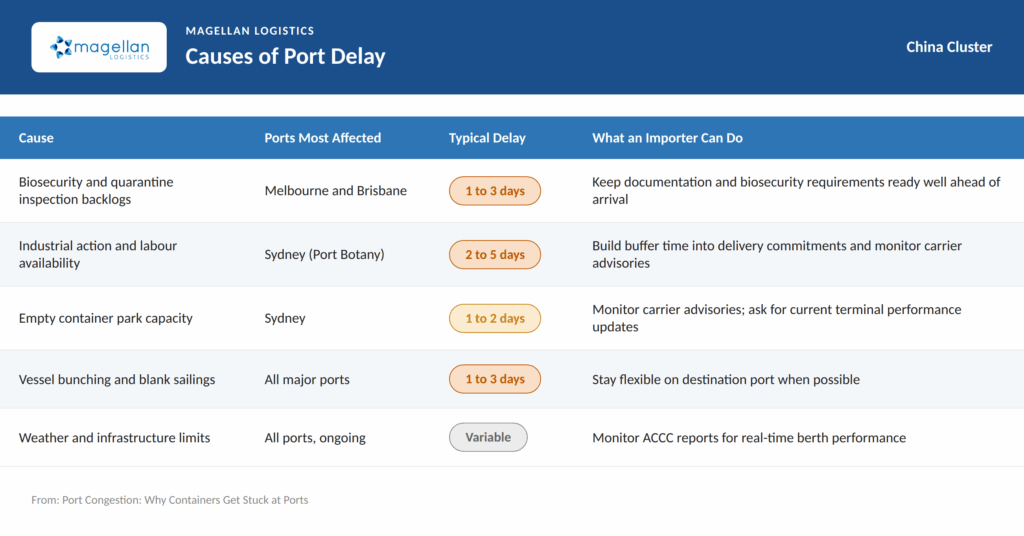
Biosecurity and quarantine inspection backlogs
Australia’s biosecurity regime is genuinely strict, and inspection capacity has not always kept pace with cargo volumes, particularly for vehicles and other high-risk goods. Melbourne and Brisbane have both reported significant delays tied specifically to quarantine inspection backlogs rather than the terminal operation itself. Because DAFF can hold a shipment independently of the ABF, how customs clearance works in Australia is worth understanding before you plan around a delay.
Industrial action and labour availability
Labour disputes and industrial action at terminals have caused some of the most severe recent disruption at Sydney’s Port Botany, with knock-on effects including empty container parks reaching capacity and shipping lines being unable to evacuate empty containers fast enough to keep pace with imports.
Empty container park capacity
When empty containers cannot be returned and shipped back out quickly enough, container parks fill up, which slows the turnaround of every container moving through the port, not just the ones already delayed. This has been a specific and material contributor to congestion at Sydney.
Vessel bunching and blank sailings
When carriers manage capacity through blank sailings or schedule changes, vessels can arrive in clusters rather than at their originally scheduled intervals, creating temporary surges in berth demand that the terminal was not resourced for on that particular day.
Weather and infrastructure limits
Severe weather can force vessels to omit a scheduled port call entirely, and Australia’s rail and yard infrastructure at some terminals has not always scaled at the same pace as container volumes. Projects such as rail duplication at Port Botany are aimed at addressing this over time, but capacity constraints remain a live issue in the meantime.
FAQ
Why do containers get stuck at Australian ports?
Containers get stuck because multiple pressures often converge at once: industrial action can reduce labour availability; biosecurity inspection backlogs can delay clearance, particularly at Melbourne and Brisbane; empty container parks can reach capacity and slow throughput; and vessel schedules can bunch or change, creating temporary surges in berth demand that exceed the terminal’s immediate capacity.
What It Costs When a Container Gets Stuck
The most expensive scenario is a vessel omitting its scheduled Australian port call entirely. When this happens, cargo is discharged at an alternative port, such as Melbourne or Brisbane instead of Sydney, and must then be relocated, adding significant cost in additional handling, terminal transfer and inland transport cost, on top of the delay itself.
During periods of severe congestion, shipping lines have also introduced congestion surcharges applied across all cargo moving through the affected port regardless of whether a specific shipment was individually delayed.
Beyond these direct costs, a container held at the terminal longer than expected is also exposed to demurrage once free time runs out. Demurrage vs detention explained sets out how free time works and where the two charges apply.
How Importers Can Plan Around Congestion
- Build buffer time into delivery commitments rather than planning against the fastest possible transit time, particularly around known peak periods.
- Ask your forwarder for current terminal performance and congestion updates before finalising a booking, rather than relying on standard published transit times alone.
- Keep documentation and biosecurity requirements ready well ahead of arrival, since inspection backlogs affect cargo that is not clearance-ready far more than cargo that is.
- Where possible, stay flexible on destination port, since some congestion events affect one Australian port far more severely than others at any given time.
- Monitor carrier advisories directly, since vessel omissions and schedule changes are usually announced with some notice. The ACCC container stevedoring monitoring reports track berth performance across Australian ports.
Stay Ahead of Port Congestion in Australia
Port congestion is one of the least predictable parts of shipping from China, but the businesses that plan for it fare far better than those that don’t. Let the experts at Magellan Logistics keep you ahead of terminal conditions on your next shipment when importing goods from China, so surprises at the port do not become surprises for your customers.
Speak to an expert and let’s start a conversation about your next shipment.
_____________________
About David Thatcher: David, founder of Magellan Logistics, has built a global career in freight forwarding. With international leadership experience and Harvard training, he remains committed to client needs and nurturing his team.