

Two Charges That Catch Out Importers Every Year
TL;DR
- Demurrage is charged when a full container sits at the port terminal beyond its free time. Detention is charged when the empty container is kept beyond its allowed return period after leaving the port. The difference is where the container is and who is waiting on it.
- Free time is typically 3 to 7 days for demurrage and 4 to 7 days for detention, though this varies by carrier, port and contract, and some Australian carrier tariffs combine both into a single free-time allowance.
- Both charges accrue daily once free time expires, and many carriers apply escalating tiers, so a delay that drags on gets progressively more expensive rather than costing the same each day.
- Demurrage and detention charges billed in Australia are subject to GST.
- Storage fees are a separate, third cost charged directly by the terminal or depot, on top of any demurrage or detention billed by the carrier.
Demurrage vs detention – what’s the difference? These are two of the most common charges importers are caught out by on the China to Australia lane, and the two terms are frequently confused for one another. Both are entirely avoidable with the right planning, but both can also escalate quickly once free time runs out.
This guide explains what each charge actually covers, how free time typically works, and the practical steps that keep containers moving before charges start.
Detention vs Demurrage?
What Is Demurrage?
Demurrage is charged by the shipping line when a full import container remains at the port terminal beyond its allotted free time. The clock generally starts once the container is discharged from the vessel and available for collection, not when the importer is notified or when customs clearance is complete. Demurrage stops accruing once the container is collected and leaves the terminal.
What Is Detention?
Detention is charged when the container, once collected from the terminal, is not returned to the carrier’s nominated depot within its allowed free time. This applies outside the port, during the period the container is being unloaded at the importer’s warehouse and transported back for return. Detention continues to accrue regardless of where the container physically sits until it is handed back.
How Free Time Works
On the China to Australia lane, managing free time is critical because delays cascade quickly once the vessel arrives. The free-time window is your buffer before charges start, and understanding exactly how it works for both demurrage and detention is the single biggest lever you have to control costs.
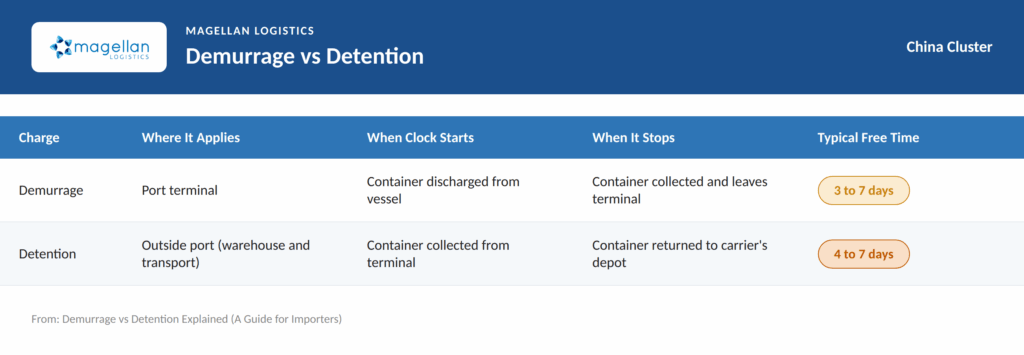
Standard free time varies by carrier, port and contract terms. Some Australian carrier tariffs combine demurrage and detention into a single free-time allowance covering both the terminal period and the time the container is out for delivery, rather than treating them as two separate clocks. It is worth confirming this detail with your forwarder for each shipment, since it changes how much buffer is genuinely available.
Once free time expires, most carriers apply escalating tiers rather than a flat daily rate, meaning the charge per day increases the longer a container is held. A short delay might cost relatively little, while a delay that stretches into a second or third week can become significantly more expensive per day than it started.
FAQ
What is the difference between demurrage and detention?
Demurrage is the charge when a full container sits at the port terminal beyond its free time; detention is charged when the empty container is not returned to the carrier’s depot within its free time after collection. The key difference is location: demurrage applies at the port, detention applies during the period the container is with you or in transit back for return.
How does free time work?
Free time is the number of days included in your freight cost before charges begin to accrue. For demurrage, the clock typically starts when the container is discharged from the vessel; for detention, it starts when you collect the container from the terminal. Once that period expires, daily charges apply, usually on escalating tiers, so delays become progressively more expensive.
How Much Do Demurrage and Detention Cost?
Rates vary by carrier, port, container type and contract terms, and change over time, so any figure should be treated as a general guide rather than a quote. Charges usually rise in tiers after free time expires, and reefer and specialised containers generally attract higher charges than standard dry containers. In Australia, demurrage and detention charges are also subject to GST. These charges sit outside the freight quote entirely, which is why our breakdown of China to Australia shipping costs treats them as a separate line.
Storage fees are a separate cost again, charged directly by the terminal or container yard for the space the container occupies, rather than by the shipping line. These can apply on top of demurrage even during the free time window in some cases, so it is worth checking with your forwarder exactly which charges apply and to whom they are paid.
Why Importers Get Caught Out
Most demurrage and detention charges trace back to the same handful of causes: customs documentation that is not ready when the vessel arrives, biosecurity holds that extend clearance beyond the expected timeframe, delayed or unavailable inland transport to collect the container, and simply underestimating how quickly free time actually runs out once weekends and processing delays are counted. Because clearance timing drives collection timing, how customs clearance works in Australia is worth reading alongside this.
Terminal-side delays outside your control matter too, and why containers get stuck at ports covers what causes them.
How to Avoid Demurrage and Detention
- Lodge customs documentation and arrange biosecurity clearance before the vessel arrives, not after, so the container is ready to move the moment it is available.
- Book inland transport in advance, including a firm collection date, rather than arranging it once the container has already been sitting at the terminal.
- Confirm the exact free time allowance and whether demurrage and detention are combined or separate for your specific carrier and contract.
- Track the vessel discharge date directly, since free time typically starts here rather than at the estimated time of arrival.
- Return empty containers to the depot promptly once unloading is complete, rather than treating the empty box as low priority.
- Where a delay is caused by port congestion or circumstances outside your control, ask your forwarder whether a waiver or extension can be negotiated with the carrier.
Avoid Unnecessary Demurrage and Detention Costs
Demurrage and detention are two of the easiest costs to avoid with the right planning, and two of the most expensive to absorb without it. Let the experts at Magellan Logistics manage the timing on your next shipment when importing goods from China, so containers keep moving and your costs stay predictable.
Speak to an expert and let’s start a conversation about your next shipment.
____________________
About David Thatcher: David, founder of Magellan Logistics, has built a global career in freight forwarding. With international leadership experience and Harvard training, he remains committed to client needs and nurturing his team.