We offer a carbon offset freight service. Click here to find out more.
Case study: Equipment Mining
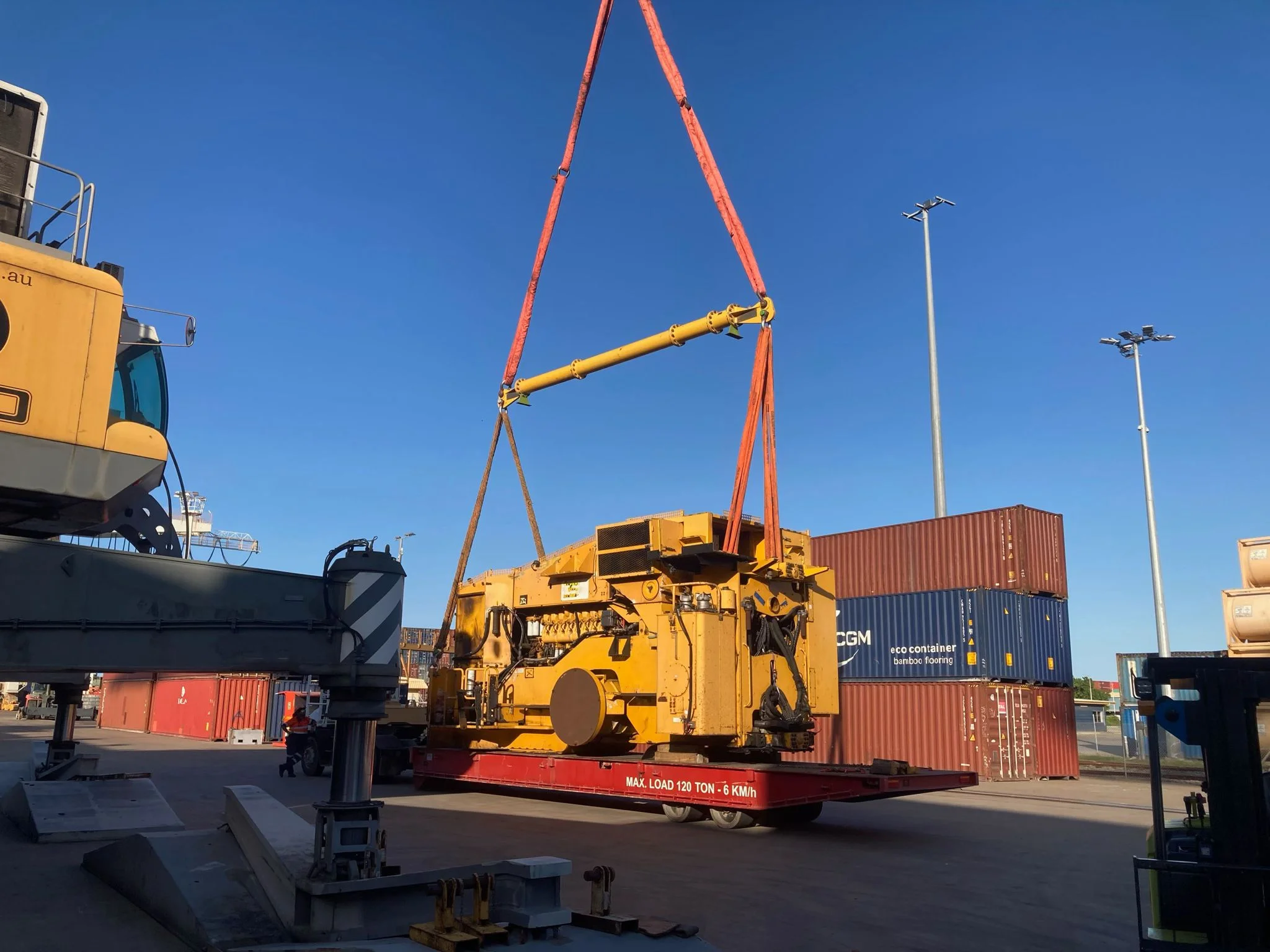
Exporting a LeTourneau L1850 front loader from Australia to South Africa for Equipment Mining, running from December 2024 to 8 February 2025.
The client had been searching for a solution for nearly three months. Other forwarders had proposed routes via Brisbane or Mackay, adding time and cost. The loader moved as 3 break bulk units: the main body at 70 tonnes and out-of-gauge in every dimension, plus the bucket and rear assembly.
Magellan identified Townsville Port as the most efficient and cost-effective route following a rapid feasibility assessment. We secured a firm, fixed-price vessel booking within 48 hours, unlocking a solution after months of delay.
Delivering it meant arranging road transport from Mackay to Townsville before the Christmas curfew, repositioning lifting gear from Singapore to meet the vessel schedule, and working around shore crane constraints during night loading. Our Projects GM was on site for loading and discharge, enabling real-time decisions and safe, compliant handling using specialised flat racks, cranes and securement.
The cargo was discharged and cleared in Durban, then delivered to the mines in Mozambique. Moving out of Townsville instead of Brisbane or Mackay saved the client both time and money.
The lesson lies in the routing decision. The obvious port isn’t always the one that works.
When break bulk beats a container
Most cargo should travel in a container. Break bulk earns its place when the cargo will not fit one, or when dismantling it to fit costs more than shipping it loose. It becomes the realistic option when your cargo shows any of the following:
- Width beyond roughly 2.35 m, the internal width of a general purpose container.
- Height beyond roughly 2.3 m, the practical limit through the door aperture.
- Length beyond roughly 12 m, which puts the piece past a standard 40ft unit.
- Weight beyond the payload the floor and lashing points are rated to carry, or point loading that concentrates it on a small footprint.
- A build that cannot be dismantled, tilted or crated without voiding a warranty.
- A shape that is awkward rather than simply large: overhangs, booms, cast sections and fixed attachments.
Cargo that fails one or two of those tests often still travels in a flat rack or open top, which keeps the container footprint and drops the walls or roof. Cargo that fails several travels as true break bulk, stowed and lashed as a single piece.
Where the shipment is one indivisible unit needing specialised vessel gear, heavy lift cargo is the closer fit.
Key features of our break bulk service
Our break bulk cargo services offer a range of features designed to meet the needs of industries requiring specialised shipping solutions.

Expertise in managing cargo that exceed standard shipping container dimensions.

Capability to ship partial loads to various destinations, optimising supply chain efficiency.

Ensuring the safe and secure delivery of valuable and delicate goods.

Use of flat-racks and open-top containers for unique cargo needs.

Our team is skilled in handling and stowing heavy machinery and industrial components.

End-to-end logistics solutions tailored to your requirements.

Strategies in place to minimise the risk of damage during transport.

Adhering to all industry standards and regulations for break bulk freight shipping.

Oversized road movements to the load port including permits, escorts and curfew planning.

Wharf cartage, customs clearance and delivery arranged on the same file.

Documents and shipment status in one place through our MagTrack portal.
Equipment and handling
Break bulk depends on having the right gear at the right port on the right day. We agree on the lifting method and securement plan before we confirm the booking, not once the cargo is on the wharf.
- Flat racks, for cargo too wide or too tall for a general purpose container but still suited to a container footprint.
- Open top containers, for cargo that must be loaded vertically by crane and fits within standard width.
- Lift-on, lift-off handling using ship’s gear or shore cranes, with crane capacity confirmed against actual piece weights.
- Lashing and securement to the vessel’s cargo securing manual, with dunnage, bearers and stoppers specified rather than assumed.
- Survey and lift supervision on complex units, so the method statement is checked on site.
Out-of-gauge is the term carriers and terminals use for the same cargo.
Cargo we regularly move as break bulk includes mining and earthmoving machinery, processing plant, structural steel, pipe in bundles or loose lengths, and prefabricated project modules.
Trusted by industry leaders
Industry expertise
With years of experience handling complex shipments, we serve industries such as construction, energy, manufacturing, and mining.
Our project teams bring 28+ years of experience navigating international supply chains across oil and gas, minerals and mining, energy, building and construction and major infrastructure projects. That experience is backed by our Australian Trusted Trader accreditation.
Tailored to your cargo needs
Our break bulk shipping services are customised to suit your cargo’s distinct dimensions and weights. We understand that not all goods fit into standard containers, and our team is ready to provide the specialised care and equipment needed to transport your items securely. We handle your cargo precisely and carefully, from construction materials to large industrial machinery.
Global shipping network
With an extensive global network, we ensure your oversized break bulk cargo reaches its destination, wherever it is. Our break bulk services provide the flexibility to ship partial loads to multiple destinations, to cater to the diverse needs of industries worldwide. We prioritise reliability and efficiency, ensuring a smooth shipping process from start to finish.
In Australia, we hold offices in Melbourne, Sydney, Brisbane and Auckland, and also service Adelaide and Fremantle, with 270+ global locations through our partner network.
Expert handling and delivery
Our experienced team is equipped to manage the complexities of break bulk shipping. We focus on secure transportation, utilising specialised equipment like flat racks and open-top containers to accommodate your cargo’s unique specifications. Committed to minimising risk and ensuring timely delivery, we support industries that require careful handling and logistics precision.
Your dedicated account manager stays with the shipment from first measurement to final delivery, with documents in one place in our MagTrack portal.
For more information on how we can support your logistics needs, please get in touch with our team today.
Call 1300 651 888 or speak with our project logistics team about your cargo dimensions, load port and timing.
Frequently asked questions
Break bulk shipping carries cargo as individual pieces loaded onto the vessel one at a time, rather than packed into a sealed container. It suits anything that exceeds standard container dimensions or weight limits, or anything that must stay assembled. The benefit is that your machinery, plant or steel travels intact, on a sailing chosen to fit its size.
Choose break bulk when the piece breaches any container limit: wider than roughly 2.35 m, taller than roughly 2.3 m, or longer than roughly 12 m. The same applies if it is heavier than the rated payload or shaped so it cannot be crated or dismantled. Between those points sit flat racks and open tops, which keep container handling while releasing a dimension or two. Send us the piece weights and dimensions and we will tell you which method fits, and why.


Download our flyer
Register to receive information on Project Logistics in your inbox.

Related Services
Retail

Import and Export of Medical Devices
Project Logistics
Helpful Resources
Get in touch with us today
Memberships & Accreditations
Magellan is proud to support




Magellan is proud to support


