
This freight market update arrives as Australian importers head into the final weeks of the peak season with mixed signals. China to Australia spot rates eased through October and congestion at several major Asian hubs improved, yet carriers have lined up six separate rate restorations and surcharges on Asia to Australia trades for November. Demand on our trade is also running well ahead of the rest of the world, up 26% year-to-date.
Further out, ships are returning to the Suez Canal and the global orderbook is close to half the size of the existing fleet. Closer to home, proposed 2027 terminal charges are set to rise well above inflation as new national guidelines for landside charges take effect on 1 January.
TL;DR – Global Freight Market Update November 2026 (9 November 2026)
- China to Australia spot rates softened after Golden Week, but four carrier groups have rate restorations and surcharges on Asia to Australia trades taking effect on 1, 10 and 15 November.
- Asia to Oceania container demand is up 26% year-to-date, the strongest growth of any major trade.
- Around 60% of Asia-Europe capacity is back on the Suez route, and CMA CGM and MSC have returned their joint Europe to Australia service to Suez.
- Proposed 2027 terminal access charge increases range from 4.5% to 38% across Australian terminals, against annual CPI of 4.3%, and DP World’s import storage fees rise 19.4%. New NTC landside charge guidelines commence 1 January 2027.
- The Australian blank sailing rate fell to 7.2%, from 13.9% three months ago, while late vessels globally still average 6.65 days behind schedule.
- Asia-Pacific air freight rates are up 28% year-on-year, and Sydney Airport’s overnight curfew exemptions for freight aircraft ended on 1 November.
Freight Market Update: Rates and Services
Global Ocean Rates
Drewry’s World Container Index fell 3% in the week to 29 October but remains around 143% higher than a year ago. Transpacific rates fell 5 to 6% over the week, while Asia to North Europe and Mediterranean rates are 8% and 12% above early October levels, although it is unclear whether carriers’ November increases will hold as more ships return to Suez.
Intra-Asia rates are flat month-on-month but still around 200% higher than in 2025. Congestion has eased at Singapore and the major Chinese ports, although waiting times at Ho Chi Minh City rose from 8 to 22 hours over the fortnight.
Australia
Asia to Australia freight rates eased in October as post-Golden Week capacity returned and Shanghai congestion improved, but that easing has not carried through to November. ANL/CMA CGM rate restorations from North East Asia, South East Asia, the Indian Subcontinent and the Middle East took effect on 1 November, alongside an MSC restoration covering 13 Asian origins. ONE’s peak season surcharge from Asia, the Indian Subcontinent and the Middle East applies from 10 November, and a further ANL/CMA CGM round and a ZIM/Gold Star Line restoration follow on 15 November. Conditions remain tighter into Fremantle and Adelaide because of congestion through Singapore.
For exporters, CMA CGM applied a rate restoration from Oceania to the US and Latin America from 2 November. Our guide to China to Australia shipping costs explains how restorations and surcharges sit on top of base rates
What this means for you
Check which November restorations apply to your bookings by origin and by effective date, as the 15 November round is assessed on Bill of Lading date for ZIM/Gold Star Line cargo. If you ship into Fremantle or Adelaide via Singapore, allow extra time for transhipment.
Freight Market Update: Suez Return and the Middle East
The return to the Suez Canal is gathering pace. Weekly capacity through the canal passed half its 2023 level in early October for the first time since the Red Sea disruption began, and by early November around 60% of Asia-Europe capacity was using the route. One forecast points to 80% of pre-diversion traffic by February 2027.
What AU/NZ Shippers Need to Know
CMA CGM and MSC have moved their joint North Europe to Australasia service, marketed as Newmo and Australia Express, back through Suez in both directions. The shorter routing lets the carriers run the same port rotation with 16 vessels instead of 18. For exporters into Europe, that points to faster transits and better equipment circulation. Carriers have kept contingency plans to divert back around the Cape of Good Hope if security deteriorates, and vessels arriving from both routes at once may cause bunching at European ports during the transition.
Very little Australian cargo moves through the Strait of Hormuz, where the Joint Maritime Information Center threat level remains at severe. The effect on our trades shows up indirectly, through war-risk insurance, fuel costs and reduced air cargo capacity through the Middle East.
What this means for you
If you import from or export to Europe, ask for confirmed routings on each booking rather than assuming Suez, and plan around the longer Cape transit time until your service has settled. Expect European arrival dates to move while vessels on the two routings converge.
Freight Market Update: Trade Outlook
Asia to Oceania Demand
Global container volumes reached a record 17.46 million TEU in August, according to Container Trades Statistics, and Asia to Oceania stands out. Demand on our trade is up 26% year-to-date and 17% year-on-year, compared with 10% for Asia to North America and 4% each for Asia-Europe and intra-Asia. The issue for Australian shippers is less about how much capacity exists globally and more about how much of it carriers choose to deploy here.
Capacity Heading Into 2027
A record 6.4 million TEU of new ships was ordered in the first ten months of 2026, taking the global orderbook to 16.6 million TEU, or 47.8% of the existing fleet. Container trade growth is forecast at around 2.1% in 2027, and shorter Suez rotations will release ships absorbed by Cape diversions, which added an estimated 10% to global vessel demand. That supply points towards lower rates over time, but carrier deployment decisions will decide how quickly it reaches Australian services.
Inflation and Landed Costs
Australian annual CPI rose to 4.3% in September, and transport was the fastest-growing major group at 8.7% year-on-year, according to the Australian Bureau of Statistics. CPI does not measure business freight costs directly, but it adds to pressure on landed costs heading into 2027.
What this means for you
When setting 2027 budgets, build in landed cost assumptions that reflect strong Asia to Australia demand in the near term rather than the longer-term supply outlook. If you are negotiating contracts, ask how carriers plan to deploy additional capacity on your specific lanes.
Freight Market Update: Regulatory Matters
New Guidelines for Landside Charges
Transport Ministers approved the National Transport Commission’s new National Voluntary Guidelines for Landside Stevedore and Empty Container Park Charges in October, commencing 1 January 2027. The guidelines extend the national framework to empty container parks for the first time. Participating operators are expected to change prices only once a year on 1 January, give at least 60 days’ notice, allow 21 days for feedback and explain the cost drivers behind each increase.
FTA and APSA support the added transparency, but early indications are that few empty container park operators have complied. Both bodies continue to push for terminal access charges and ECP booking fees to be recovered from the commercial customer buying the service, with a mandatory code overseen by the ACCC where needed.
Terminal Access Charges for 2027
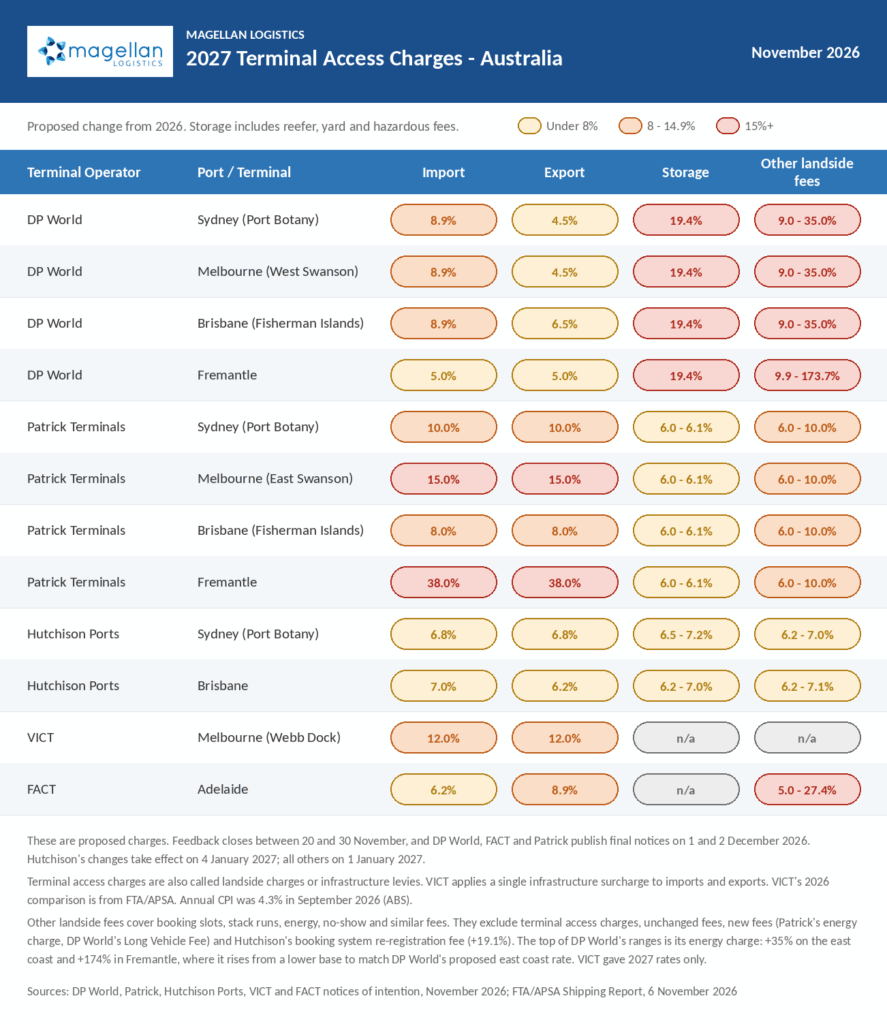
Notices issued by Australia’s container terminal operators between 2 and 4 November show proposed 2027 terminal access charges rising well above CPI at most terminals. Patrick’s charges rise 38% at Fremantle, 15% at East Swanson Dock in Melbourne, 10% at Port Botany and 8% in Brisbane. DP World’s import charges rise 8.9% in Sydney, Melbourne and Brisbane, with export charges up 4.5 to 6.5%, while Hutchison’s rise 6.2 to 7.0%. VICT’s infrastructure surcharge rises 12%.
Storage is rising too. DP World’s import storage, reefer, yard handling and hazardous fees rise 19.4% at all four of its terminals, compared with around 6 to 7% at Patrick and Hutchison. Patrick will also introduce a additional energy charge, and DP World a fee for vehicles over 26 metres in Sydney and Fremantle. Terminal access charges are levied on transport operators. Final notices are due in early December, so figures may still change.
What this means for you
Expect higher terminal access and infrastructure charges on carrier and transport invoices from January 2027, and allow for them in landed cost calculations for cargo arriving after 1 January. Storage and other ancillary fees are also rising, so prompt container collection will matter more next year.
Freight Market Update: Global Schedule Reliability and Port Congestion
Global schedule reliability improved 0.9 percentage points to 50.6% in September, according to Sea-Intelligence, the first rise after three monthly falls from a May peak of 64.5%. Around half of vessels are still arriving late, and late vessels averaged 6.65 days behind schedule. None of the 13 major carriers improved on a year earlier.
Global Port Congestion
Singapore has dropped from second place to outside the global top ten congestion hotspots, while Shanghai is unchanged. Congestion remains elevated across Asia, and European ports are under pressure from industrial action and vessel bunching.
What this means for you
Plan around actual vessel performance rather than published schedules, and keep a buffer of at least a week for time-critical stock. Check the latest arrival date for each container before you book deliveries or labour.
Freight Market Update: Capacity Management and Blank Sailings
Global
Drewry expects 56 cancellations across the major East-West trades between 2 November and 7 December, around 8% of 715 scheduled sailings. The Gemini Cooperation has the lowest projected blank sailing rate at 1%.
Australia
The blank sailing rate on Australian services fell to 7.2%, from 8.8% last month and 13.9% three months ago. Carriers are holding capacity on Australian services fairly steady despite softer seasonal demand, although schedule disruption and port omissions continue to affect available space on some sailings.
What this means for you
Fewer cancellations make sailing plans more dependable, but confirm your booking a week before cut-off and ask whether your vessel is calling at every scheduled port. Omissions can still change the discharge port at late notice.
Freight Market Update: Equipment
Container shortages in Asia stem from positioning rather than supply. Congestion and longer rotations at Shanghai, Ningbo and Singapore have slowed the return of empty containers, leaving some export hubs in China and South East Asia short of 40-foot and 40-foot high cube boxes. Reefer equipment remains tight globally.
What this means for you
Give your suppliers’ booking requests more lead time for 40HC and reefer equipment, and consider whether 20-foot or standard 40-foot boxes could work for some orders.
Freight Market Update: Sustainability
Maersk has completed the first commercial ship-to-ship ethanol bunkering of a deep-sea container vessel in the United States. DNV reports 364 alternative-fuel vessels ordered in the first ten months of 2026, up 57%, but fuel supply is falling behind. Lloyd’s Register counts 385 methanol-capable vessels on order, while only 25 ports offer methanol bunkering. Businesses looking to reduce the footprint of their freight today can explore carbon offset freight options.
What this means for you
If you report on supply chain emissions, ask your carriers which fuels their vessels on your lanes actually use, as fuel availability at port will shape real-world emissions for some years.
Air Freight Market Update
Global
Air cargo rates continued to rise through late October as the peak season built. WorldACD data shows full-market rates around 31% higher than last year, and Asia-Pacific rates 28% higher. Capacity from the Middle East and South Asia, an important connection for Australia to Europe airfreight, remains well below earlier 2026 levels.
Australia and New Zealand
From 1 November, Sydney Airport removed curfew exemptions that allowed some freight and propeller aircraft to operate overnight, now that Western Sydney International is available for night movements. Brisbane Airport has announced a 30-hectare industrial land release for logistics and warehousing, with its existing precincts at 100% occupancy.
What this means for you
Book air freight for Christmas stock early and expect limited uplift on Europe routings through the Middle East. Time-critical overnight freight into Sydney may now route through Western Sydney International, so check delivery arrangements for that change.
Terminals and Ports
Australia
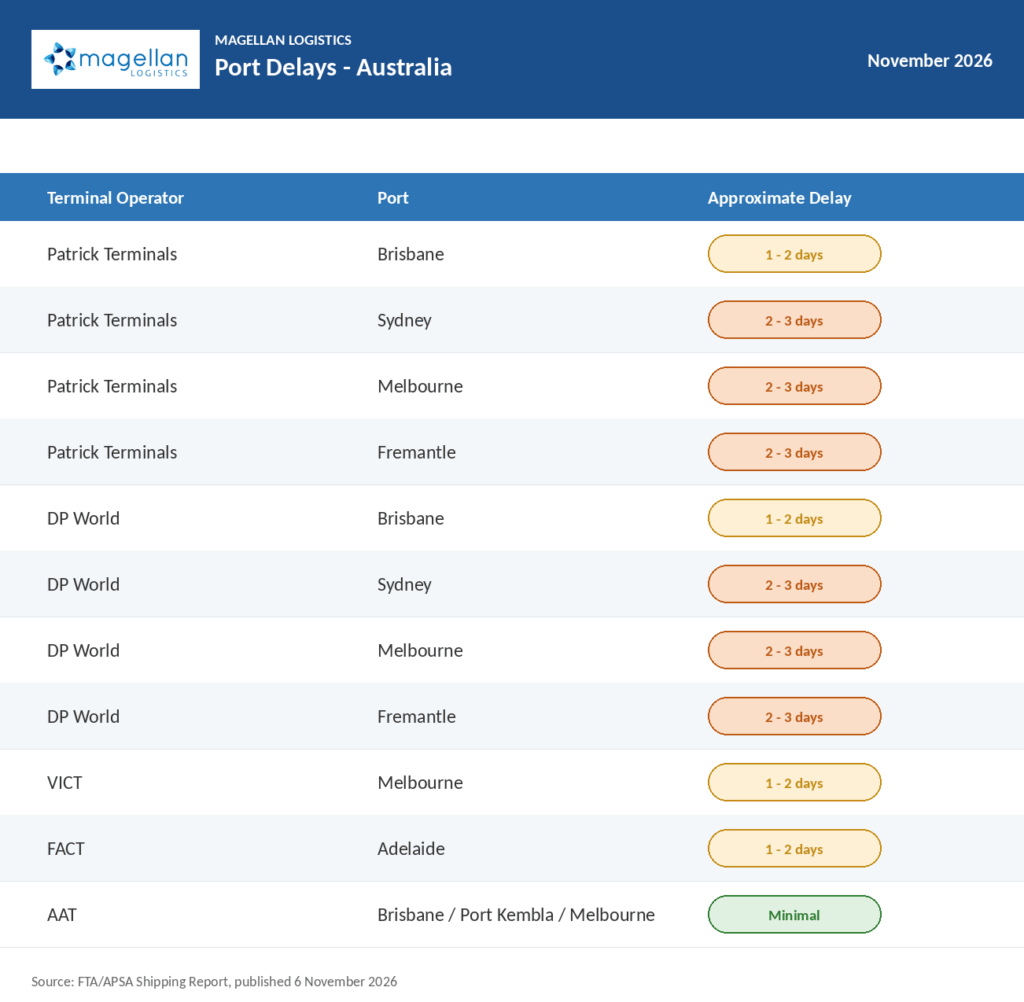
Australian Border Force data for September shows 687,000 sea cargo reports lodged, up 10% month-on-month but down 3% year-on-year. Air cargo reports rose 19% year-on-year to 16 million, and export declarations were up 4%. Terminal delays reported by FTA are unchanged from recent months.
Darwin Port faces protected industrial action by MUA and AMOU members from 7 to 11 November, building to a 24-hour stoppage on 11 November. The port expects minimal interruption, though delays are possible.
New Zealand
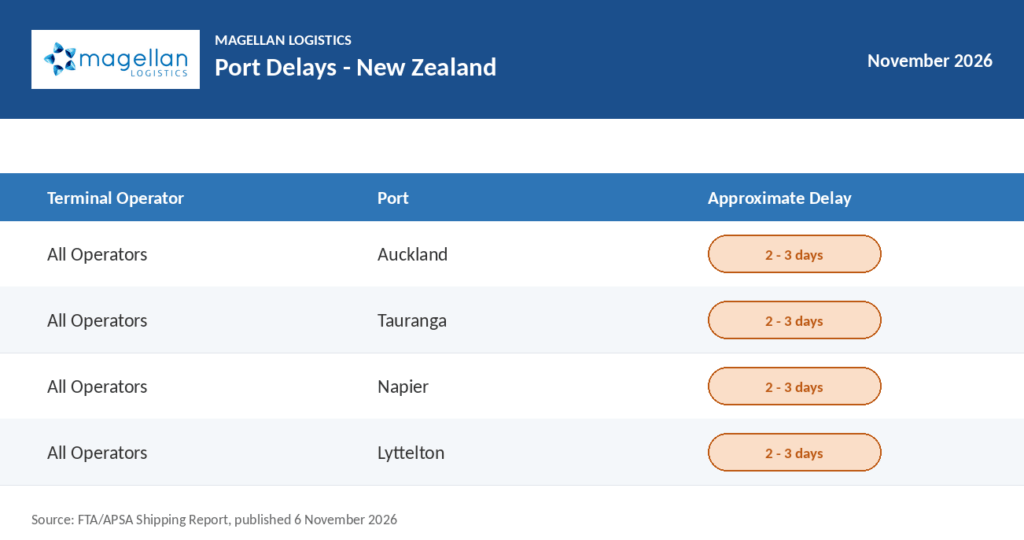
Delays of around 2 to 3 days continue at Auckland, Tauranga, Napier and Lyttelton.
Notable Infrastructure and Regulatory Developments
MOVe Logistics began a trans-Tasman service through Port of Newcastle’s Mayfield multipurpose terminal on 27 October, giving Hunter region importers and exporters a direct link to New Zealand for containerised, breakbulk and project cargo without moving through Sydney.
What this means for you
Allow 2 to 3 days of terminal delay in Sydney, Melbourne, Fremantle and the main New Zealand ports when planning deliveries and container collections. If you move freight through Darwin this week, check vessel and cut-off times daily.
The Bottom Line
November’s freight market update comes down to timing. In the near term, strong Asia to Oceania demand and a new round of carrier rate restorations are holding Asia to Australia freight rates up into the peak season, even as spot rates soften. Through 2027, the return to the Suez Canal and a record orderbook will add capacity that should eventually work in shippers’ favour, provided carriers deploy it on Australian trades.
Landside costs deserve equal attention. Proposed 2027 terminal access charges rise well above inflation at most terminals, and the new NTC guidelines will only help if operators follow them.
If you would like to talk through what this means for your shipments or your 2027 planning, your dedicated account manager is ready to help. Speak to an expert, and let’s start a conversation.
Read previous freight market updates and the latest logistics insights at Freight Forwarding News and Insights – Magellan Logistics
About David Thatcher: David, founder of Magellan Logistics, has built a global career in freight forwarding. With international leadership experience and Harvard training, he remains committed to client needs and nurturing his team.
Sources: With thanks to the Freight and Trade Alliance for their freight market update. Figures attributed to Drewry, Sea-Intelligence, WorldACD, UNCTAD, Container Trades Statistics, the World Trade Organization, DNV, Lloyd’s Register, the National Transport Commission, Australian Border Force, and the Australian Bureau of Statistics, as reported in the latest FTA/APSA Shipping Report. The 2027 terminal charges from notices of intention issued by DP World, Patrick Terminals, Hutchison Ports, VICT and Flinders Adelaide Container Terminal in November 2026.