
What Really Makes Up Your Landed Cost
Your landed cost includes far more than the headline ocean freight rate. It encompasses all the surcharges, customs duties, taxes and handling charges from factory gate to warehouse door. Understanding each component and where costs can be negotiated or optimised is essential to avoid budget blowouts.
TL;DR
- Ocean freight is only one line on the invoice. Landed cost also includes fuel and peak season surcharges, terminal handling at both ends, customs duty, GST, an Import Processing Charge, brokerage and inland transport.
- Ocean freight alone is priced per container and has been running above a typical, more settled market.
- GST of 10 per cent applies to the customs value plus freight, insurance and any duty, not just the goods price (ATO).
- Customs duty on Chinese-made goods is typically 0 to 5 per cent, and many products qualify for 0 per cent under ChAFTA with a valid Certificate of Origin (DFAT).
- The Import Processing Charge ranges from around $50 to $192 depending on shipment value and lodgement method (Australian Border Force fee schedule).
- Demurrage and detention sit outside the freight quote entirely, and can add materially to cost if containers are not cleared and returned on time.
This guide breaks down each component of that landed cost, what drives China-to-Australia shipping costs, and where the most common hidden costs sit. Costs are one part of shipping from China to Australia – the full guide covers timelines, customs and forwarder selection.
Many importers price a shipment from China to Australia off a single number: the ocean freight rate. That number is rarely the number that actually lands on the invoice. By the time a container clears an Australian port and reaches the warehouse, freight is usually one of six or seven separate charges, and the gap between the quoted rate and the landed cost is where most budget blowouts happen.
The Components of Your China to Australia Shipping Landed Cost
Your China-to-Australia landed cost is built from eight components: ocean freight, carrier surcharges, terminal handling charges, customs duty, GST, an Import Processing Charge, customs brokerage and inland transport. Each is calculated differently, and several can be negotiated or optimised to reduce total cost.
| Component | Who Charges It | How It Is Calculated | Negotiable |
|---|---|---|---|
| Ocean freight | Carrier | Per 20ft or 40ft container (FCL) or per cubic metre (LCL) | Yes |
| Fuel and peak season surcharges | Carrier | Additional charges (BAF for fuel, PSS during peak periods) on top of base rate | Partly |
| Origin and destination handling | Export/import terminals | Terminal handling, documentation, wharfage, container examination (if selected) | Some items |
| Customs duty | Australian Customs and Border Protection | 0–5% of customs value, or 0% with valid ChAFTA Certificate of Origin | No (but optimisable) |
| GST | Australian Taxation Office (ATO) | 10% of customs value plus freight, insurance and any customs duty | No |
| Import Processing Charge | Australian Border Force | $50–$192 fixed fee depending on shipment value and lodgement method | No |
| Customs brokerage | Licensed customs broker | Flat or near-flat fee per shipment | Yes |
| Inland transport | Freight forwarder or transport operator | Based on distance from port and metro versus regional destination | Yes |
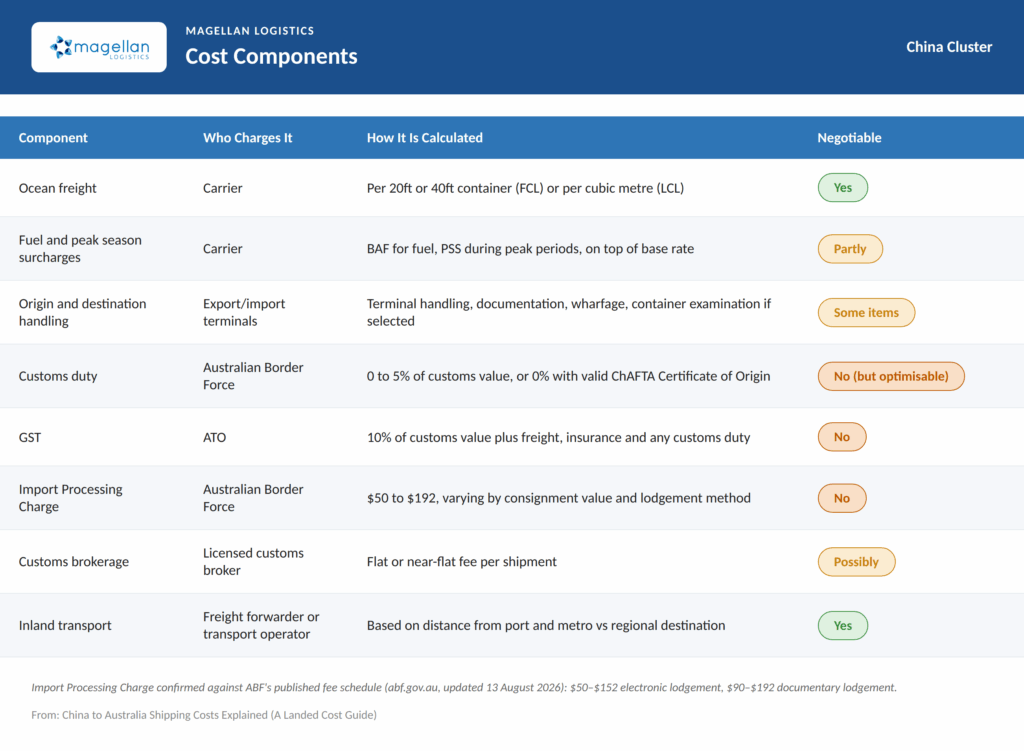
China-to-Australia landed-cost components. The accessible table above contains the same information.
1. Ocean freight (the base rate)
This is the carrier’s charge for moving a container, or a share of a container, from the origin port to the Australian port of discharge. It is quoted per 20ft or 40ft container for Full Container Load (FCL), or per cubic metre for Less than Container Load (LCL).
2. Fuel and peak season surcharges
Carriers add a range of surcharges on top of the base rate, most commonly BAF for fuel and PSS during peak periods, which are the run-up to Christmas stocking and the weeks before Chinese New Year factory closures. Both can move independently of the base freight rate. Ocean freight surcharges explained section covers what each one is and which are negotiable.
3. Origin and destination handling charges
Terminal handling charges apply at both ends: export terminal handling and documentation fees in China, and import terminal handling, wharfage and container examination charges (if your shipment is selected for inspection) in Australia. On a lower base freight rate, these accessorial charges can rival the ocean freight cost itself.
4. Customs duty
Duty on imports from China is typically 0 to 5 per cent of the customs value, depending on the tariff classification. Under the China-Australia Free Trade Agreement, a large majority of Australian imports from China now qualify for 0 per cent duty, provided a valid Certificate of Origin is held. Our guide to importing from China with ChAFTA explains rules of origin and how to certify them. Getting the tariff classification and ChAFTA eligibility right at the outset is one of the more reliable ways to reduce landed cost, and how customs clearance works in Australia explains where in the process that assessment happens.
5. GST
GST is charged at 10 per cent, calculated on the customs value plus international freight, insurance and any customs duty payable, not simply on the invoice price of the goods. This is the calculation importers most often get wrong when estimating costs upfront, since it is a tax on the landed value rather than the purchase price.
6. Import Processing Charge
The Australian Border Force charges an Import Processing Charge for lodging the import declaration, ranging from around $50 for low-value, electronically lodged consignments up to $192 for full formal entries with a consignment value over $10,000. Current amounts are published on the ABF Import Processing Charge schedule. This is a fixed administrative fee rather than a percentage of shipment value.
7. Customs brokerage
Most importers use a licensed customs broker, either standalone or as part of their freight forwarder’s service, to lodge the import declaration and manage classification. Brokerage is typically a flat or near-flat fee per shipment, separate from the IPC itself. For the end-to-end process, see how customs clearance works in Australia and how international shipping works.
8. Inland transport
Delivery from the Australian port to the final warehouse or distribution centre is priced separately, and varies significantly with distance from the port and whether the destination is metropolitan or regional. For businesses outside Sydney, Melbourne or Brisbane, inland transport can be a higher cost than expected relative to the ocean freight itself.
What Drives China to Australia Shipping Costs
For a breakdown of carrier-imposed components, see Ocean freight surcharges explained.
At current market conditions, importers typically budget USD 2,800–5,600* per container for the ocean freight component alone, depending on container size, carrier and route. This sits higher than a typical, more settled market and is subject to rapid change due to capacity constraints, fuel surcharges, equipment availability and global route disruptions.
This is a general market indication rather than a specific carrier quote.
Volatility is driven by several factors at once: carriers tightening capacity through blank sailings ahead of the traditional third quarter peak season, rising fuel and bunker surcharges, tight equipment and container availability, and broader disruption to global vessel routing and operating costs. Rates on this lane can move materially within a single month, which is unusual even by the standards of a market that is always somewhat seasonal. For a wider explanation of these upstream pressures, see how global events affect shipping.
Because of this, the single most useful thing an importer can do is request a transparent, all-in quote rather than pricing off the headline ocean freight number, and confirm pricing again close to the actual booking date. Rates move for reasons that often start a long way from this lane, and how global events affect shipping explains how that transmission works.
Hidden Costs Importers Miss
Several charges sit outside the standard freight quote and can catch both first-time and experienced importers by surprise if they are not factored into cost planning from the outset. Demurrage and detention, container examination charges and biosecurity treatment can each add significantly to your landed cost.
Demurrage and detention
Demurrage applies once a container exceeds its free time at the port terminal, and detention applies once an empty container is kept past its allowed return period after leaving the port. Both accrue daily and are entirely avoidable with prompt collection and container return. Our guide to demurrage vs detention sets out how free time works and where the two charges differ.
Container examination charges
If the Australian Border Force or biosecurity authorities select a shipment for physical inspection, examination and any required treatment are charged to the importer, on top of the standard terminal handling fee.
Biosecurity treatment
Goods affected by seasonal measures, such as those shipped from China during the Brown Marmorated Stink Bug risk season between 1 September and 30 April, require treatment by an approved provider, which is a cost outside the base freight quote.
How to Manage Freight Costs
Cost management on this lane depends on planning ahead, negotiating where possible and using clear landed-cost quotes rather than headline ocean freight rates. Working with a logistics partner who understands the China-to-Australia lane and the specific cost drivers means you can budget accurately and avoid surprise charges.
A few practical habits make the biggest difference to landed cost on this lane:
- Request a landed cost quote, not just an ocean freight rate, so surcharges, duty, GST and inland transport are visible upfront.
- Confirm ChAFTA eligibility and hold a valid Certificate of Origin wherever it applies, since duty savings flow directly into a lower GST base as well.
- Book ahead of peak periods, particularly the pre-Christmas rush and the weeks before Chinese New Year, when both rates and available space move quickly.
- Clear customs promptly and arrange container collection and return within free time to avoid demurrage and detention.
- Work with a forwarder who reconfirms pricing close to your actual booking date, given how quickly rates are currently moving.
FAQ
How much does it cost to ship a container from China to Australia?
A typical 40ft container of goods from China to Australia carries ocean freight of approximately USD 2,800–5,600* depending on carrier, route and current market conditions. However, the total landed cost, including surcharges, duty, GST, handling charges, brokerage and inland transport, typically runs much higher. Request a transparent, all-in landed cost quote from your freight forwarder rather than pricing from the headline ocean freight rate alone.
This is a general market indication rather than a specific carrier quote.
Do I need to pay GST on goods imported from China?
Yes, GST of 10 per cent applies to all imports from China regardless of value. GST is calculated on the customs value of the goods plus ocean freight, insurance and any customs duty payable, not just the invoice price. This calculation catches many importers by surprise, as it is a tax on the landed value rather than the purchase price, so it is important to factor it into your cost estimate upfront.
Want a Clear, all-in cost estimate for your China to Australia shipping costs?
Freight pricing on this lane moves quickly, and a headline ocean rate rarely tells the full story. Let the experts at Magellan Logistics put together a transparent landed cost estimate for your next shipment when importing goods from China, so you can plan with confidence.
Speak to an expert and let’s start a conversation about your next shipment.
__________________
About David Thatcher: David, founder of Magellan Logistics, has built a global career in freight forwarding. With international leadership experience and Harvard training, he remains committed to client needs and nurturing his team.