

Why Your Invoice Is Rarely the Number You Were Quoted
TL;DR
- A quoted ocean freight rate is a base rate, not the final cost. Ocean freight surcharges for fuel, currency, peak demand and terminal handling sit on top, and several of them float or change with little notice.
- The most common recurring surcharges are BAF (fuel), CAF (currency), GRI (general rate increase), PSS (peak season) and THC (terminal handling). BAF alone typically adds 5 to 15 per cent to the base freight rate.
- Emergency surcharges, such as war risk or emergency bunker surcharges, can appear within 24 to 48 hours of a global disruption.
- Some surcharges are genuinely non-negotiable (BAF, CAF), while others (GRI, some THC) can be discussed with a forwarder who has volume leverage.
- The single best protection against surcharge surprises is a transparent, all-in quote, confirmed close to your actual booking date.
A freight quote that turns into an invoice noticeably larger than the number you agreed is one of the most common complaints importers raise about ocean freight, and it is rarely a billing error. It is the predictable result of a base rate that never included the full picture. Surcharges are only part of it, and our breakdown of China to Australia shipping costs covers the rest of the landed cost. Carriers layer a range of freight surcharges on top of the headline freight rate to cover costs that move independently of it, from fuel prices to currency risk to sudden global disruption.
This guide explains the surcharges you are most likely to see on a China-to-Australia shipment, what each one actually covers, and how to protect your budget from the ones that move without warning. For the wider picture, our guide to shipping from China to Australia covers the full process.
Recurring Ocean Freight Surcharges Explained
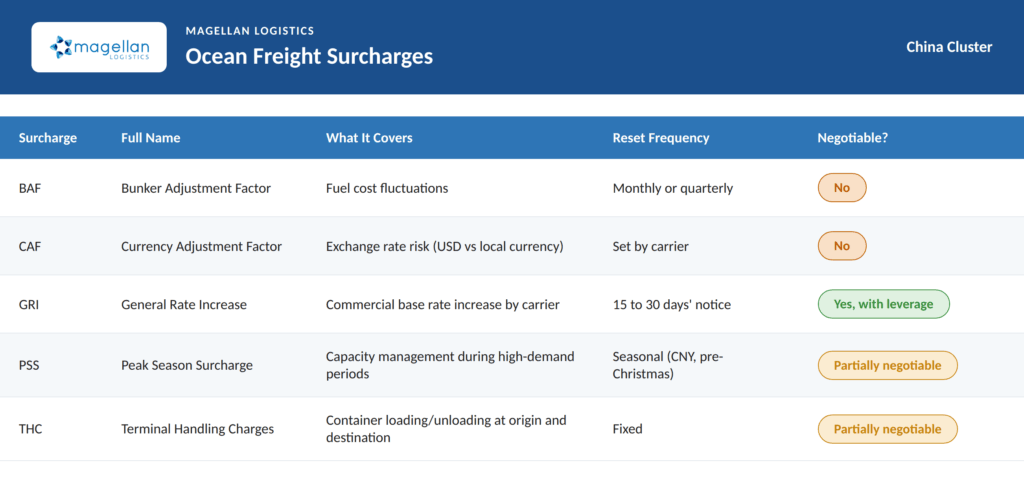
When importing from China, you will encounter five main recurring surcharges that stack on top of the base freight rate. Each one has different causes, reset schedules and negotiability. The table below breaks down each surcharge: what it actually costs, how it moves, and whether you have room to negotiate. Understanding which ones shift independently of your base freight rate is the key to accurate budget forecasting and protecting yourself from invoice surprises.
BAF (Bunker Adjustment Factor)
BAF is the most significant recurring surcharge on most China-to-Australia shipments, typically adding 5 to 15 per cent to your base freight rate, and it floats monthly or quarterly depending on the carrier. It covers the cost of fuel and is the most significant recurring surcharge on most ocean freight invoices, typically adding somewhere in the order of 5 to 15 per cent to the base freight rate. It floats with global fuel prices and is usually reset monthly or quarterly depending on the carrier, meaning a quote accepted several weeks before sailing may not reflect the BAF actually applied at departure. BAF is generally not negotiable, since it is a standardised, index-linked adjustment applied uniformly by the carrier.
CAF (Currency Adjustment Factor)
CAF protects the carrier against exchange rate movements between the US dollar (the standard currency for shipping) and local currencies, and it is set by the carrier, not negotiated. CAF protects the carrier against exchange rate movements between the US dollar, the standard currency for shipping, and the currencies in which the carrier incurs local costs. It is usually calculated as a small percentage of the base freight rate and, like BAF, is set by the carrier rather than negotiated.
GRI (General Rate Increase)
A GRI is a commercial rate increase by the carrier announced 15 to 30 days ahead, and it is one of the more negotiable surcharges if you ship regular volume through a forwarder with carrier leverage. A GRI is a blanket increase to the base freight rate itself, applied by carriers across a trade lane, typically announced 15 to 30 days ahead of implementation. Unlike BAF and CAF, a GRI is a commercial decision by the carrier rather than a cost pass-through, and it is one of the more negotiable surcharges for importers who ship regular volume through a forwarder with genuine carrier leverage.
PSS (Peak Season Surcharge)
PSS applies during the run-up to Chinese New Year factory closures and the pre-Christmas stocking rush, when available space tightens and carriers use pricing to manage capacity. PSS applies during high-demand periods when available space is tight, most relevantly for this lane in the run-up to the pre-Christmas stocking rush and the weeks before Chinese New Year factory closures. It is designed to help carriers manage capacity as much as recover cost, and space, not just price, is often the real constraint during these windows.
Terminal Handling Charges (THC)
THC covers the cost of container loading and unloading at the origin terminal in China and the destination terminal in Australia, and while generally fixed, it can sometimes be negotiated as part of a broader forwarder relationship. THC covers loading, unloading and handling of the container at the terminal, and applies separately at origin in China and at destination in Australia. THC is charged regardless of fuel or currency movements and is sometimes negotiable as part of a broader forwarder relationship, though less so than a GRI.
Emergency and Event-Driven Surcharges
Alongside the recurring ocean freight surcharges above, carriers can introduce emergency charges with very little notice in response to sudden global disruption, most commonly an Emergency Bunker Surcharge (EBS) during a sudden fuel price spike, or a War Risk Surcharge (WRS) when a route becomes genuinely unsafe to transit.
Dated example: Strait of Hormuz crisis (February 2026)
Within days of the late February 2026 disruption, Hapag-Lloyd suspended Strait of Hormuz transits, and carriers introduced emergency and war-risk surcharges on Gulf-linked cargo. These measures applied to affected Middle East services, not directly to the China-to-Australia lane. The broader increase in fuel, insurance and network costs nevertheless added pressure to global shipping markets. How global events affect shipping explains the three channels through which distant disruption can reach a freight rate.
FAQ
Which ocean freight surcharges are negotiable?
It depends on the surcharge. BAF and CAF are standardised, index-linked adjustments and are rarely open to negotiation regardless of volume. GRI, some THC arrangements and destination charges are more genuinely negotiable, particularly for importers shipping consistent volume through a forwarder with strong carrier relationships. Emergency surcharges introduced in response to a sudden global event are generally applied uniformly across a carrier’s entire booking book and are not negotiable in the short term, whatever the underlying cause.
How to Protect Your Budget from Ocean Freight Surcharge Surprises
- Request an all-in, landed cost quote that explicitly lists which surcharges are included, rather than pricing off the base freight rate alone.
- Check the validity date on any quote. If your vessel sails after that date, a new BAF or GRI is likely to apply.
- Ask your forwarder which surcharges are fixed and which are open to negotiation, particularly if you ship regular volume.
- Book ahead of known peak periods, since PSS and available space both work against you the closer you get to Chinese New Year or the pre-Christmas rush.
- Stay close to your forwarder’s market updates during any period of global disruption, since emergency surcharges can be introduced within days.
Get an All-In Quote, Not a Surprise Invoice
Surcharges are where freight budgets get caught out. Let the experts at Magellan Logistics give you a transparent, itemised quote for your next shipment when importing goods from China, so you know exactly what you are paying for before you book.
Speak to an expert and let’s start a conversation about your next shipment.
_____________________
About David Thatcher: David, founder of Magellan Logistics, has built a global career in freight forwarding. With international leadership experience and Harvard training, he remains committed to client needs and nurturing his team.