

A Complete Guide to How International Shipping Works for Australian Importers
TL;DR
- International shipping works by following a consistent sequence: booking, export documentation, international transport, customs clearance, and final delivery, regardless of the origin country.
- The Incoterm agreed with your supplier, such as EXW, FOB or CIF, determines who controls freight booking, who bears risk at each stage, and how much visibility you have over the real cost of your shipment.
- Sea freight suits bulk, non-urgent cargo and is the standard choice for most China-to-Australia shipments. Air freight is faster but considerably more expensive.
- Several distinct parties are involved in every shipment, including the exporter, freight forwarder, carrier, customs broker and transport provider, and confusion over who is responsible for what is a common source of delay.
- Understanding this process end to end is what allows importers to plan realistic timelines and identify where in the chain a delay or extra cost is likely to originate.
Importing goods internationally involves more than moving cargo from one country to another. It requires coordination across a supplier, a freight forwarder, one or more carriers, a customs broker and a transport provider, each with their own documentation and their own point at which something can go wrong.
This guide explains how the end-to-end international shipping process works, the terms and parties involved, and where the most common issues arise, with a particular focus on shipments from China to Australia.
For Australian importers, sourcing from China means navigating a complex supply chain with multiple handoffs. A typical China-to-Australia shipment involves six distinct stages: your freight forwarder books space with a carrier, your Chinese supplier prepares export documentation and hands goods to the carrier, cargo travels across the Indian Ocean, the Australian Border Force clears the shipment on arrival, you pay duty and GST, and finally a transport provider delivers to your door. Each stage involves different parties, different timelines, and different regulatory requirements. Understanding where responsibility shifts between parties helps you anticipate delays and plan realistic delivery dates.
The International Shipping Process, Step by Step
International shipping from China to Australia follows five sequential stages: booking cargo with a freight forwarder, preparing export documentation, arranging ocean transport, clearing customs on arrival, and delivering the cargo to your final destination. Each stage involves distinct parties and decision points, and delays at any point can cascade through the entire timeline.
1. Booking cargo
The process begins when an importer engages a freight forwarder to arrange the shipment. The forwarder assesses cargo details, recommends a transport mode, and books space with a carrier. Decisions made here, particularly around routing and container type, shape the cost and timeline for everything that follows.
2. Preparing export documentation
Before cargo can leave the origin country, the exporter prepares the commercial invoice, packing list, and export declaration, along with a bill of lading or air waybill once the goods are handed to the carrier. Errors at this stage are one of the most common causes of delays much later in the process.
3. International transport
Cargo travels by sea or air. Ocean freight is the standard choice for bulk or non-urgent shipments and is significantly more cost-effective, while air freight suits urgent or high-value goods at a proportionally higher cost.
4. Arrival and customs clearance
On arrival, the goods must be cleared through customs before release. In Australia, this means an import declaration lodged with the Australian Border Force, assessment of duty and GST, and biosecurity clearance where required. How customs clearance works in Australia covers both agencies and where each can hold a shipment.
5. Final delivery
Once cleared, cargo is released from the port and delivered to its final destination, either by the freight forwarder or a separate inland transport provider.
Incoterms: Who Is Responsible for What
The Incoterm you agree with your supplier determines who controls booking, who bears risk and cost at each stage, and how much visibility you have over your true landed cost. For China-to-Australia shipments, FOB, CIF and DDP are the most common.
A key element of how international shipping works is that the Incoterm agreed with your supplier determines who controls booking, who bears risk at each stage, and how much visibility you have over your true landed cost. The four terms importers encounter most often are EXW, FOB, CIF and DDP, each shifting cost and risk at a different point in the journey. Our full explainer on Incoterms sets out what each one covers, and the Incoterms chart of responsibility shows the split at a glance.
For most importers bringing goods in from China, FOB offers the best balance of simplicity and cost control, since it keeps origin-side logistics with the supplier while letting the importer choose their own forwarder for the main leg and see the real China to Australia shipping costs rather than a supplier’s marked-up rate.
Key Parties Involved in How International Shipping Works
Every international shipment involves six main parties, each with distinct responsibilities. Understanding who does what helps you identify where delays originate and who to contact when problems arise.
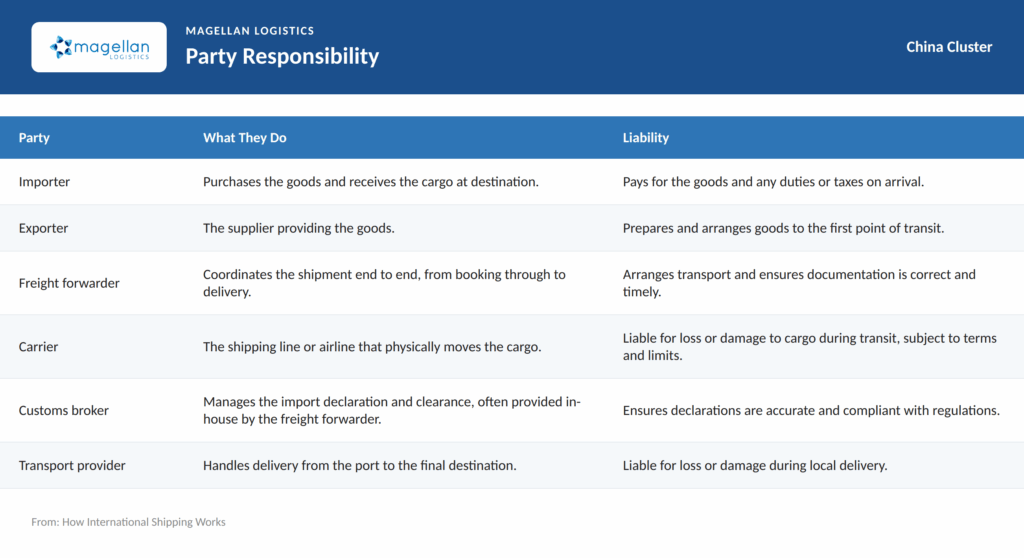
A significant share of shipping problems trace back to unclear responsibility between these parties, particularly under Incoterms like CIF where the supplier controls a leg of the journey the importer cannot directly see.
Ocean Freight vs Air Freight
Ocean freight is the standard choice for most China-to-Australia shipments because it is significantly cheaper; air freight is reserved for urgent, high-value or time-critical cargo where cost is less important than speed.
Most importers use ocean freight as their primary mode and reserve air freight for genuinely urgent or high-value shipments. Ocean freight offers substantially lower cost per unit but takes considerably longer and requires more advance planning. Air freight moves in days rather than weeks, at a proportionally much higher cost, and is generally reserved for smaller, time-critical or high-value cargo. For the China lane specifically, our complete guide to shipping from China to Australia covers how both modes work in practice.
Where Importers Often Go Wrong
The most common shipping mistakes are underestimating transit times, misunderstanding Incoterms and their cost implications, leaving documentation until the last minute, and missing free-time windows for container collection. Each is avoidable with the right planning.
- Underestimating realistic transit times, rather than planning against the fastest quoted figure.
- Not understanding which Incoterm they are buying under, and what it means for cost visibility and risk.
- Treating documentation as something to sort out once goods have already arrived, rather than preparing it in advance.
- Leaving container collection until after free time has already started running.
These and other common import mistakes are avoidable with the right process in place.
Let Us Manage the Complexity
International shipping involves genuine complexity across multiple parties, documents and decision points. Let the experts at Magellan Logistics manage your supply chain so you can focus on what truly matters: running your business.
Speak to an expert and let’s start a conversation about your next shipment.
_____________________
About David Thatcher: David, founder of Magellan Logistics, has built a global career in freight forwarding. With international leadership experience and Harvard training, he remains committed to client needs and nurturing his team.