

TL;DR: Customs clearance times for imports vary widely—from under 24 hours to 30+ days—depending on documentation accuracy, product classification, regulatory compliance, and customs efficiency. In Australia, compliant shipments usually clear in 1–3 days, but delays are common with biosecurity inspections, peak-season backlogs, or incomplete paperwork.
- Accurate documentation is your fastest route to clearance – complete commercial invoices, packing lists, and certificates prevent immediate delays.
- Proper tariff classification and valuation prevent costly scrutiny and rework.
- Leverage FTAs and TCOs – Certificates of Origin can reduce duties and often coincide with quicker processing.
- Biosecurity compliance is non-negotiable – ensure contamination-free packaging and valid treatment certificates.
- Engage licensed customs brokers to navigate complexity and avoid common pitfalls.
“How long will customs clearance take?”
This remains one of the most challenging questions we encounter from clients. Clearance times can range from a few hours to several weeks, creating uncertainty that affects your entire supply chain planning.
We understand the frustration this creates for businesses. One shipment clears customs within 24 hours, while an identical consignment the following week faces days of delays. This variability stems from numerous factors that often catch importers off guard, particularly those new to Australian customs procedures.
The uncertainty surrounding customs clearance times presents particular challenges for businesses importing into Australia. Documentation completeness, tariff classification accuracy, and biosecurity requirements all play crucial roles in determining how quickly your goods clear customs. Peak shipping seasons can extend these timeframes further, disrupting carefully planned delivery schedules.
Understanding the factors that influence clearance times empowers you to take proactive steps to minimise delays. We’re here to guide you through the key elements that affect customs processing, helping you prepare your shipments for smoother, more predictable clearance.
Key factors affecting customs clearance times
- Document accuracy and completeness
- Proper tariff classification and valuation
- Duty payment arrangements and compliance history
- Type of goods and biosecurity requirements
- Seasonal volumes and inspection protocols
Addressing these five areas before your goods arrive can significantly reduce delays and improve supply chain reliability.
What is Customs Clearance and Why It Matters
Customs clearance serves as the critical gateway between your international shipments and their final destination. This process determines whether your goods can legally enter Australia and directly impacts how quickly they reach you. See the Australian Border Force (ABF) guide: How to import and DAFF’s overview of clearance and inspection.
The Fundamentals of Customs Processing
- Border Protection
- Safeguarding consumer safety through product compliance checks (see ABF trade & goods compliance)
- Preventing prohibited goods from entering Australian markets
- Protecting domestic industries from unfair competition
- Revenue Collection
- Calculating and collecting duties and taxes
- Ensuring accurate valuation of imported goods (see ABF on valuation)
- Verifying compliance with trade agreement requirements
We understand that customs clearance can appear to be just another administrative step, but it represents a vital checkpoint that maintains both border security and economic integrity. While not every shipment undergoes physical examination by border or biosecurity authorities, importers must prepare proper documentation as random compliance checks can occur at any point (see DAFF’s inspection process).
Who Manages Your Customs Clearance?
Licensed Customs Brokers
Licensed customs brokers manage the complexities of this process on your behalf. These professionals act as intermediaries between government agencies and importers, handling declaration documents, calculating duties and taxes, and ensuring proper classification according to the Harmonised System. See ABF’s overview of customs broker licensing.
Freight Forwarders with Customs Licences
Many freight forwarders hold corporate customs broker licences, enabling them to provide clearance services alongside their shipping operations. Others partner with specialised brokerage firms to offer comprehensive logistics solutions.
Self-Lodgement Options
Importers can self-lodge declarations through Australia’s Integrated Cargo System (ICS), though most businesses find engaging a licensed customs broker more efficient. Learn more via ABF’s ICS guidance.
The expertise of customs professionals becomes particularly valuable when addressing the five key factors that influence clearance times: documentation accuracy, classification precision, valuation methods, compliance history, and goods type. Their knowledge helps prevent the delays that commonly affect unprepared shipments.
Documents That Can Speed Up or Delay Your Clearance
Documentation accuracy serves as the foundation for efficient customs clearance. A single missing document or incorrect detail can extend your waiting time from hours to days, making thorough preparation your most effective strategy for avoiding delays.
Commercial Invoice and Packing List
The commercial invoice acts as the cornerstone of your customs documentation, supported by a detailed packing list. Australian customs authorities require specific details to process your shipment efficiently:
- Invoice terms clearly stated (FOB, CIF, or other agreed terms)
- Complete seller information, including name and address
- Currency denomination (AUD, USD, or other applicable currency)
- Accurate country of origin declaration
Incomplete or vague invoices trigger additional scrutiny from customs officials, often resulting in extended processing times. A detailed packing list complements your commercial invoice by providing transparency about your shipment’s contents, dimensions, weight, and packaging specifications. This clarity enables officials to verify that declared goods match the actual shipment, potentially eliminating the need for physical inspections. See ABF’s How to import for context.
Bill of Lading or Air Waybill
Your Bill of Lading for sea freight or Airway Bill for air freight establishes legal proof of ownership and serves as evidence that the carrier has accepted responsibility for your goods. Customs officials require properly executed transportation documents to verify the rightful ownership of shipments. Missing or incorrectly completed bills create immediate processing delays as officials cannot determine legitimate claim to the goods.
Import Declaration and Permits
Australia operates a tiered system for import declarations by value. Goods with a customs value at or below AUD 1,000 are lodged on a Self-Assessed Clearance (SAC), while higher-value consignments require a formal Import Declaration (N10). See the ABF SAC factsheet (PDF) and DAFF’s SAC cargo. For Import Declarations, see ABF’s Import declarations.
Many first-time importers find the ICS interface challenging to navigate effectively. Engaging with experienced customs brokers often proves more efficient, as their familiarity with the system helps avoid common lodgement errors that cause processing delays.
Certificate of Origin and Preference Documents
Certificate of Origin documentation can significantly accelerate your clearance process by qualifying your goods for preferential tariff treatment under Free Trade Agreements. This certification confirms your goods originated from countries holding established trade agreements with Australia, potentially reducing or eliminating applicable duties while expediting processing times. See ABF’s origin advice and DFAT’s guidance (e.g., ChAFTA certificates of origin).
Packing Declaration and Quarantine Documents
Australia maintains strict biosecurity controls that directly impact clearance timeframes. Goods containing wood or plant materials require Quarantine Packing Declaration documentation to demonstrate compliance with Australia’s stringent contamination prevention standards.
Timber packaging materials must meet specific treatment requirements and remain completely bark-free to prevent pest introduction. Failure to provide proper biosecurity documentation can result in shipment re-export or destruction at your expense, making advance preparation essential for maintaining delivery schedules.
Review DAFF’s policies for Minimum Documentary Requirements and Non-commodity information requirements, plus the official packing declaration templates: FCL template (DOCX) | LCL template (PDF).

How Duties, GST, and Valuation all Impact Customs Clearance Timing
Financial preparation plays a critical role in determining your customs clearance speed. Accurate duty calculations and prompt payment arrangements can accelerate your goods’ release, while valuation errors or payment delays can extend clearance times significantly.
How customs duty is calculated
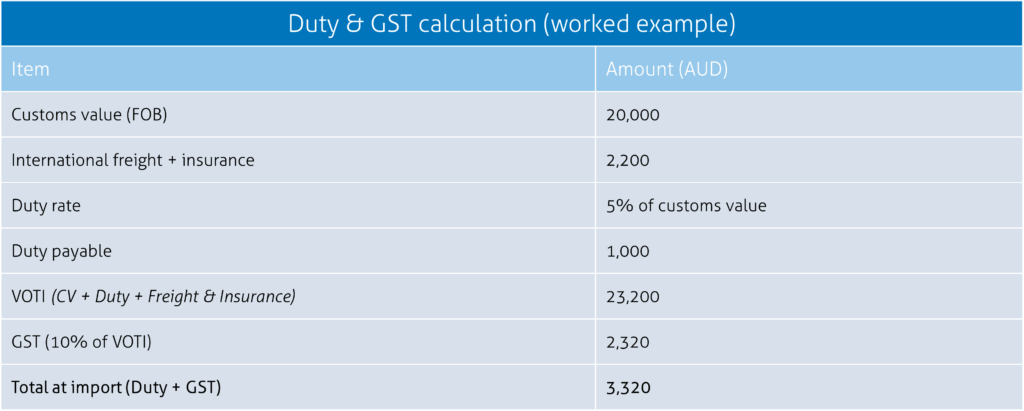
Most general cargo imported into Australia attracts a standard customs duty rate of 5% based on the Free On Board (FOB) value. The Australian Border Force applies different calculation methods depending on your goods’ classification:
- “Free” – zero duty applies to qualifying goods
- “Calc” – percentage rates applied to the customs value
- “Lower/Higher” – comparison of multiple calculation methods
Your import declaration’s tariff classification and treatment codes determine which method applies, directly affecting processing speed. Consult ABF’s Tariff – Schedule 3 and valuation rules here.
When GST applies and how to claim credits
GST at 10% applies to virtually all imported goods, regardless of your registration status. This calculation encompasses your goods’ customs value, applicable duties, transport costs to Australia, and insurance coverage. The Department of Home Affairs requires GST payment before releasing goods from customs control.
GST-registered businesses can claim input tax credits when:
- The importation qualifies as taxable
- Goods serve a creditable business purpose
- You imported the goods for your enterprise
For an overview of import costs (GST and other taxes), see ABF’s page here.
Deferred GST Scheme for Importers
Eligible businesses can defer GST payment until their Business Activity Statement (BAS) is due, improving cash flow while maintaining compliance. This scheme requires:
- Current Australian Business Number
- GST registration status
- Monthly BAS lodgement online
- Electronic payment methods
This arrangement allows you to postpone tax obligations without delaying customs clearance.
Review the ATO’s Deferred GST scheme and ABF’s overview of deferral of GST.
Tariff classification and valuation methods
Australia employs an 8-digit coding system based on the Harmonised System (HS) for goods classification. Precise classification ensures accurate duty calculations and prevents delays from customs queries.
The transaction value method determines most goods’ value—essentially the actual price paid with specific adjustments. Accurate declared values prevent scrutiny that could otherwise extend your clearance timeline.
Free Trade Agreements and TCOs
Tariff Concession Orders (TCOs) eliminate customs duty on goods not manufactured in Australia. Free Trade Agreements (FTAs) similarly reduce or eliminate duties between participating countries.
These concessions require proper documentation, particularly Certificates of Origin, but offer substantial benefits through reduced costs and expedited processing times.
See ABF’s Tariff Concession Orders and DFAT’s guidance on rules of origin.
Compliance, Biosecurity, and Common Delays
Incorrect Classification or Undervaluation
Misclassifying goods under the wrong Harmonised System code frequently triggers Australian Border Force (ABF) scrutiny. This error not only results in incorrect duty calculations but can also lead to substantial fines and extended inspection periods.
Undervaluing goods to reduce duty payments presents even greater risks. This serious offence can result in seizure of your shipment and significant penalties. The Australian Border Force actively monitors for valuation discrepancies, and their detection systems have become increasingly sophisticated.
See ABF’s approach to trade & goods compliance and the Infringement Notice Scheme guide (PDF).
Missing or Incorrect Documentation
Documentation errors can halt your clearance process entirely. When customs officials cannot verify the ownership, origin, or contents of your shipment, the clearance process stops immediately. Even minor discrepancies in spelling, dates, or descriptions can trigger delays that extend for days.
Thorough document preparation before shipment departure remains your most effective strategy for avoiding these delays. Our customs team regularly assists clients in reviewing documentation to ensure accuracy and completeness.
Biosecurity Risks and Restricted Goods
Australia enforces stringent biosecurity controls to protect its unique environment. All containers must arrive free from contamination, including soil, plant material, and insects. Timber packaging requires treatment using approved methods and must be completely bark-free to prevent pest introduction.
Items failing to meet biosecurity requirements face immediate re-export or destruction at the importer’s expense. The Department of Agriculture, Fisheries and Forestry conducts thorough inspections, and non-compliance carries significant financial consequences.
Check import conditions in BICON. Timber packaging must meet ISPM-15 and be bark-free—see DAFF guidance on bark and timber packaging. For container cleanliness and the Sea Container Hygiene System, see DAFF’s SCHS page, – book inspections via DAFF’s inspection booking.
Labelling and Packaging Issues
Australian import regulations specify clear labelling requirements under the Commerce (Trade Descriptions) Act 1905. Labels must appear in English with prominent, legible characters, display the country of origin accurately, and include precise product descriptions.
Products with inadequate labelling face immediate seizure. This requirement applies to both the product itself and its packaging, making proper labelling preparation essential for smooth customs clearance.
ABF’s labelling requirements, the Commerce (Trade Descriptions) Act 1905, and the Commerce (Trade Descriptions) Regulation 2016. For apparel care labelling, see Product Safety Australia’s mandatory standard.
Product Safety and Environmental Standards
Products entering Australia must meet mandatory safety standards before they can be supplied to the market. Environmental standards apply particularly to items using electricity, water, or fuel, including specific emissions standards for outdoor power equipment and marine engines.
Failing to comply with these standards results in significant fines and clearance delays. The Australian Competition and Consumer Commission actively enforces these requirements, making compliance verification crucial before shipping.
Random Inspections and Red Flags
The ABF and DAFF conduct risk-based and random inspections regardless of your compliance history. However, certain factors increase inspection likelihood: inconsistent documentation, unusual shipping routes, or first-time importer status.
Despite perfect preparation, random checks remain an unpredictable factor in customs clearance timing. While you cannot eliminate this possibility, maintaining consistent documentation and established shipping patterns can reduce your profile for additional scrutiny.
See ABF’s overview of risk and compliance.
Conclusion
Understanding the factors that affect customs clearance time empowers you to take control of your import operations. We’ve explored how documentation accuracy, classification precision, valuation methods, compliance history, and goods type all play crucial roles in determining your clearance timeline. Proper preparation across these areas forms the foundation of reliable, efficient customs processing.
Customs clearance can feel like an unpredictable bottleneck in your supply chain. However, treating it as a critical checkpoint from the earliest planning stages transforms this challenge into a manageable process. Working with experienced customs brokers helps you address Australia’s strict regulations, particularly around biosecurity controls and documentation requirements.
Small errors in classification or valuation can trigger extended inspections that add days or weeks to your timeline—another reason to “get it right the first time”. Successful importers develop comprehensive pre-shipment checklists covering all documentation, classification, valuation, and compliance requirements.
The time invested in proper preparation delivers measurable returns through faster clearance times, reduced storage costs, and more predictable delivery schedules. Whether you’re importing for the first time or managing regular shipments, this proactive approach significantly improves your customs experience and overall operational efficiency.
_____________
Magellan Logistics provides freight and logistics services to all industries, including sea freight, air freight, customs clearance, project logistics, carbon offset freight, and MagTrack’s digital freight portal, providing 24/7 visibility of all your shipments.
Get in touch: 1800 595 463 to discuss how we can help streamline your customs clearance processes.
_____________
About Duncan Graham: With over 20 years as a Licensed Customs Broker Duncan is committed to his ethos of exceeding customers’ expectations and the quest for operational excellence. Having had exposure to all facets of forwarding, Duncan isn’t surprised by anything and deftly handles all freight scenarios that come his way.
FAQs
What are the main factors that affect customs clearance time?
The primary factors include document accuracy, proper tariff classification, correct valuation of goods, compliance history, and the type of goods being imported. Addressing these areas can significantly reduce delays.
How long does customs clearance typically take in Australia?
There’s no official SLA. Low-risk consignments with complete documentation often clear within 1–2 days, but timing varies with inspections, documentary issues and seasonality. See ABF’s How to import and DAFF’s clearance & inspection.
What can cause delays in customs clearance?
Common causes include incorrect or missing documentation, improper tariff classification, undervaluation, biosecurity risks, and random inspections. Issues with labelling, packaging, or product safety standards can also lead to holdups (see ABF’s compliance and DAFF’s inspection process).
Can I speed up the customs clearance process?
Yes. Ensure all documentation is complete and accurate, properly classify your goods, utilise FTAs where applicable, and comply with biosecurity regulations. Engaging a licensed customs broker can help navigate the process more efficiently.
What happens if my shipment is delayed in customs?
Delays may be due to missing paperwork, pending instructions, or requests for additional information. Contact your broker, carrier or the relevant authority to address outstanding issues promptly.
Sources:
Department of Agriculture, Fisheries and Forestry (DAFF)
Department of Foreign Affairs and Trade (DFAT)
Australian Taxation Office (ATO)