
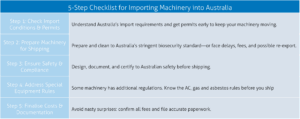
TL;DR: Successfully importing machinery into Australia requires careful planning and strict compliance with biosecurity and safety regulations to avoid costly delays and penalties. The following 5 steps
- Apply for permits at least 20-40 business days before shipping, using the BICON tool to check specific requirements for your machinery type
- Thoroughly clean all used machinery to remove soil, seeds, and organic materials—Australia enforces zero-tolerance biosecurity policies with re-export consequences
- Ensure safety compliance through pre-shipment testing, design registration for specific equipment, and meeting Australian WHS standards before arrival
- Address special requirements for air conditioning systems, refrigerant gases, and asbestos testing with proper documentation from accredited laboratories
- Budget for total costs, including 10% GST, 5% duty, import processing charges, biosecurity fees, and consider marine insurance protection
The key to successful machinery importation lies in meticulous preparation and understanding that Australian authorities prioritise protecting their ecosystem and worker safety above all else. Starting the permit process early and working with experienced freight forwarders can significantly streamline this complex regulatory journey.
Importing Machinery into Australia
Importing machinery into Australia calls for careful planning, with permit applications typically due at least three weeks before the arrival of your goods.
However, Australia’s robust economy and growing industries offer a solid justification for importing machinery. Importers and suppliers, however, do have significant responsibilities. You must take all reasonable precautions to ensure that the equipment you are importing does not pose a risk to the health and safety of the people who will handle it. This includes assembly staff, end users, and even those who will decommission and dispose of the machinery in the future.
The financial considerations extend beyond the standard 10% GST applied to all imports. Shipments valued over $1,000 incur an Import Processing Charge payable to Customs. These costs represent just the beginning of your import expenses.
Australia’s regulatory framework carries serious consequences for non-compliance. The government maintains the right to re-export non-compliant machinery at your expense. All imported equipment becomes subject to biosecurity controls upon entering Australian waters, with specific cleaning requirements that must be followed precisely.
We recognise the complexities involved in bringing machinery into Australia. The guide provides a comprehensive framework for importing machinery, including obtaining necessary permits, preparation steps, compliance requirements, special equipment rules, and cost control measures. Our goal is to explain this process, so your essential equipment reaches its destination without experiencing delays or penalty charges.
Step 1: Check Import Conditions and Permits
Your success in importing machinery depends on your ability to understand the import requirements of Australia. The process of obtaining necessary permits in advance will stop delivery delays and border inspection problems that result in equipment rejection.
Use the BICON tool to check requirements.
The Biosecurity Import Conditions system (BICON) functions as your primary tool to find out what import requirements apply to your situation. This online database helps you establish whether your equipment: security Import Conditions system (BICON) serves as your primary resource for determining specific import requirements. This online database enables you to establish whether your equipment:
- Is permitted for entry into Australia
- Requires specific biosecurity import conditions
- Needs supporting documentation
- Must undergo treatment before arrival
- Requires a biosecurity import permit
Search for your specific machinery type within the BICON database to access detailed information about all applicable requirements. The system also allows you to apply for, track and manage import permits through your registered user account.
Australia maintains strict biosecurity measures to protect its plant and animal health. All machinery imported into Australia must be completely free from contamination, including seeds, soil, plants, and animal materials. The Department of Agriculture, Fisheries and Forestry holds the authority to re-export contaminated machinery at your expense should you fail to comply.
When to Apply for Vehicle Import Approval
Machinery classified as vehicles requires approval from the Department of Infrastructure, Transport, Regional Development, Communications and the Arts. Remember this crucial point: never arrange transportation of your equipment to Australia until you have secured the appropriate approval document.
Your specific vehicle type determines which approval you’ll need:
- Vehicle type approval
- Concessional Register of Approved Vehicles (RAV) entry approval
- Non-RAV entry import approval
- Reimportation import approval
These approvals include permission to import your vehicle and remain mandatory, regardless of the vehicle’s value. You can still apply for authorisation while your shipment is in transit, even if you’ve already initiated shipping—although this approach carries significant risks.
Timeframes and Costs for Permit Processing
Planning your import timeline requires understanding processing periods for different permits. Here are the key timeframes to consider:
Biosecurity Import Permits:
- Standard (category 1) applications: 20 business days
- Non-standard (categories 2-5) applications: 40 business days after payment and submission of completed application
Processing times may be extended if your application requires a technical assessment, if you provide incomplete information, additional details become necessary, or if your product is novel.
Costs Involved:
The BICON permit application process includes a $130 application charge. You must also pay an initial assessment fee, based on your goods category, which reflects the expected duration of the assessment. The department will not evaluate your application until full payment of both fees has been received.
Vehicle Import Approvals:
Expect approximately 30 working days for assessment of a completed application with all supporting documentation. An application does not automatically guarantee approval; each submission is thoroughly reviewed.
Step 2: Prepare Machinery for Shipping
Proper machinery preparation is the essential second step. The country maintains stringent biosecurity regulations to safeguard its distinctive natural environment. The cleaning requirements present a challenging task, but non-compliance leads to time-consuming delays, extra cleaning fees, and forced re-exportation, which you must pay for.
Cleaning Requirements for Used Machinery
Australia maintains a zero-tolerance policy for biosecurity risk material on imported machinery. The Department of Agriculture, Fisheries and Forestry requires all used machinery to arrive completely free from contamination such as seeds, soil, plant and animal materials. This strict policy exists to protect Australia’s plant and animal health from potential foreign threats.
Australian authorities define “clean” machinery as equipment that has undergone comprehensive cleaning addressing all possible contamination sites. Upon arrival, biosecurity officers conduct thorough inspections and have final discretion on whether your machinery meets the required standard.
The consequences of inadequate cleaning are significant:
- Machinery with low-level contamination requires additional cleaning at an approved arrangement site
- Heavily contaminated machinery may be directed for export from Australia
- All additional handling, cleaning or re-export costs fall to the importer
Dismantling for Effective Cleaning
Many types of used machinery may require partial or complete dismantling to ensure they can be thoroughly cleaned. This applies especially to agricultural, mining, construction, and food processing equipment that may have come into contact with soil or organic materials.
Dismantling provides access to hidden areas where contaminants frequently accumulate. The Department of Agriculture, Fisheries and Forestry provides specific cleaning guides and checklists for different machinery types, helping importers understand common areas where biosecurity risk material typically accumulates.
These detailed guides cover numerous machinery categories:
- Articulated dump trucks, excavators and dozers
- Compactors, motor graders and scrapers
- Forklifts, tractors and skid steer loaders
Each guide contains both pictorial and written explanations of problem areas that require special attention during cleaning. While these resources are valuable, the department emphasises they are not exhaustive, and importers bear full responsibility for meeting all biosecurity requirements.
Avoiding Biosecurity Risk Material (BRM)
Biosecurity risk material (BRM) encompasses any material of biosecurity concern, including seeds, soil, grain, plant and animal material. Maintaining cleanliness throughout transportation becomes vital to prevent recontamination during shipping.
Even machinery categorised as “new” must comply with biosecurity requirements if it has been field-tested or factory-trialled and has come into contact with soil, animal, or plant material. Authorities consider such equipment “used” and subject it to the same stringent inspection protocols.
For mining machinery specifically, some flexibility exists if the exporter can declare on company letterhead that the machine has only been used more than two metres below ground. Authorities may accept some hard, ‘baked-on’ sub-soil in difficult-to-access places, provided all loose material is removed.
The following four steps outline the essential procedures for importing goods successfully.
Understand the cleaning guide appropriate to your specific machinery type
- Dismantle components as required to access all potential contamination points
- Maintain cleanliness during transportation to prevent recontamination
- Document your cleaning process thoroughly
Meticulous machinery preparation before shipping significantly increases the likelihood of swift clearance through Australia’s biosecurity controls, saving both time and money during the importation process.
The process of preparing machinery with precision before shipping leads to faster biosecurity clearance in Australia, resulting in time and cost savings for importation.
Step 3: Ensure Safety and Compliance
Safety compliance extends beyond cleaning requirements and permits when importing machinery into Australia. Protecting your investment and the people who will operate your equipment requires meeting Australian safety standards—a responsibility that begins well before your machinery reaches Australian shores.
Testing and Inspection Before Shipment
Pre-shipment testing reduces the risk of delays and rejection upon arrival. You must ensure that all machinery is inspected according to the manufacturer’s provided information. If testing is required as part of this information, you must complete this testing before the machinery arrives.
Thorough inspection is mandatory for used machinery upon arrival in Australia. Pre-shipment inspection provides several advantages:
- Identifies non-compliant features that can be addressed before shipping
- Confirms machinery meets Australian safety standards
- Documents compliance for customs clearance
- Reduces the potential for costly remediation work after arrival
The level of inspection should be based on what’s necessary to ensure confidence in the product’s safety. This becomes particularly important when dealing with new suppliers or those with a history of compliance issues.
Design Registration for Certain Equipment
Design registration under Australian Work Health and Safety (WHS) regulations is mandatory for various types of plant equipment. Pressure equipment requires registration if categorised as Hazard Level A, B, C or D according to AS 4343:2005 criteria.
Other equipment requiring design registration includes:
- Tower cranes and self-erecting tower cranes
- Lifts, escalators and moving walkways
- Hoists with platform movement exceeding 2.4 metres
- Concrete placing booms
- Mobile cranes with a rated capacity greater than 10 tonnes
Design registration must be completed before supplying equipment to anyone in Australia. Penalties for non-compliance are substantial.
Safety Features Required Under WHS Laws
Australian WHS laws require machinery to have appropriate safety features, regardless of whether it is manufactured overseas. Tractors and agricultural equipment must have safety switches preventing the machine from starting while in gear or with power take-off engaged.
Machinery must comply with Australian standards even when marketed as “fully compliant” overseas. Standard safety requirements include:
- Roll-over protective structures (ROPS) that meet Australian standards
- Emergency stop controls that are readily accessible
- Appropriate guarding on moving parts
- Controls and labels in English
- Electrical compliance with Australian standards
Any modifications made to meet these requirements mean you take on the designer’s work health and safety duties, requiring updated design registration for the modified design.
Step 4: Address Special Equipment Rules
Certain types of machinery require additional regulatory consideration beyond standard import procedures. We understand that equipment containing air conditioning systems, refrigerant gases, or potential asbestos materials presents unique compliance challenges that can significantly impact your import timeline and costs.
Handling Machinery with Air Conditioning
Equipment incorporating air conditioning systems must comply with Australia’s Ozone Protection and Synthetic Greenhouse Gas Management Act. This requirement applies to various types of machinery, including cars, caravans, earth-moving equipment, and drilling rigs. You’ll need to verify whether existing air conditioning systems use banned refrigerants such as chlorofluorocarbons (CFCs) or hydrochlorofluorocarbons (HCFCs).
Australia implemented additional restrictions effective 1 July 2024, banning the import of small air conditioning equipment using refrigerants with a global warming potential (GWP) of over 750. This prohibition applies even when equipment arrives without refrigerant. The restriction applies to units with a refrigerant charge of up to 2.6 kg, designed for cooling or heating stationary spaces to maintain human comfort.
Refrigerant Gas Licensing and Exemptions
Machinery containing synthetic greenhouse gases or ozone-depleting substances typically requires an equipment licence (EQPL). The non-refundable application fee is AUD 458.700. However, several exemptions may apply to your situation:
- Personal use exemption: No licence required if you’ve owned the equipment for more than 12 months overseas for private use and are importing it for personal use in Australia
- Low volume exemption: Import up to 25 kilogrammes of synthetic greenhouse gases in equipment during a calendar year without a licence
- Degassed equipment: Air conditioning systems arriving without refrigerant need documentation from an HVAC vendor confirming this status
Equipment licences generally expire after two years, unless authorities specify a shorter duration.
Asbestos Testing and Documentation
All forms of asbestos have been banned in Australia since 2003. This prohibition extends to machinery components, including brake pads, gaskets, engine insulation, and electrical parts, that may contain asbestos.
Imports of used machinery require evidence that all components are asbestos-free. This necessitates representative sampling and testing by an accredited laboratory. The Australian Border Force (ABF) accepts only microscopic analysis from accredited laboratories; readings from portable devices are insufficient.
Testing reports must be in English and include:
- Test method used
- Sample description
- Fibre detection results
- Accreditation organisation details
Should the ABF suspect asbestos content despite your documentation, they may detain your machinery for additional testing. This can result in significant delays and unexpected costs that impact your project timeline.
Step 5: Finalise Costs and Documentation
Understanding all financial obligations and documentation requirements represents the final critical step in importing machinery into Australia. Proper preparation at this stage ensures your equipment clears customs promptly without unexpected costs.
Breakdown of GST, Duty, and Customs fees
All machinery imported into Australia typically incurs a 10% Goods and Services Tax (GST) calculated on the total of customs value, insurance, freight, and import duty. Most machinery is subject to a standard 5% duty rate on the Free on Board (FOB) value, although some equipment may qualify for duty-free importation.
Your total import costs will include:
- 5% duty on FOB value (unless exempt)
- 10% GST on CIF plus duty
- Import processing charges
- Biosecurity fees
GST-registered businesses can often claim a GST credit for the tax paid on imported goods used for business purposes.
Packing Declarations and Import Processing Charges
Packing declarations serve as mandatory documents to ensure biosecurity risks are mitigated in container packing materials. The entity that packed or observed the packing of goods—typically the exporter, supplier, or packer—must issue these declarations.
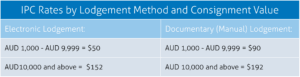
The Australian Border Force (ABF) applies Import Processing Charges (IPCs) based on the consignment value and lodgement method (electronic vs. documentary). Consignments under AUD 1,000 generally have no charge, while consignments above this threshold incur charges that differ depending on the lodgement method used.
The Department of Agriculture collects biosecurity charges on behalf of DAFF.
Marine Insurance: Is It Worth It?
The substantial investment involved in importing machinery makes marine insurance valuable protection against potential damage during transit. Used machinery typically attracts higher premiums due to the increased risk associated with it.
Marine cargo insurance covers physical loss or damage to goods being transported by air, sea, rail, or road [25]. Two primary options are available: annual coverage for regular importers or single-journey policies for one-time shipments.
Considering the significant value of industrial machinery, as well as all associated import costs, marine insurance represents a prudent investment against unforeseen events that may occur during international transit.
Conclusion
Successfully bringing machinery into Australia depends on thorough preparation and strict adherence to the country’s regulatory requirements. The systematic approach outlined in this guide provides a clear pathway through the complexities of permits, biosecurity standards, safety compliance, and financial planning.
Compliance remains non-negotiable when importing machinery into Australia. The authorities maintain these strict standards to protect both the country’s unique ecosystem and the safety of its workers. This means that securing permits, cleaning equipment properly, meeting safety requirements, adhering to special equipment rules, and preparing accurate documentation must all be completed before your shipment departs.
Planning Effectively Prevents Costly Delays:
- Permit applications should begin at least 20-40 business days before shipping
- Vehicle import approvals typically require 30 working days for assessment
- Customs processing takes additional time upon arrival
- Biosecurity inspections may extend timelines further if issues arise
Understanding the complete financial picture helps you budget accurately. Beyond the purchase price of your machinery, factor in GST (10%), potential duty (5% for most machinery), import processing charges, biosecurity fees, and marine insurance. These additional costs can be substantial, particularly for high-value equipment.
We recommend partnering with experienced freight forwarders who are familiar with Australian regulations. Their expertise helps avoid common pitfalls and can significantly expedite the clearance process.
While importing machinery into Australia involves multiple regulatory steps, proper preparation ensures your equipment arrives safely, legally, and ready for immediate use. The investment in careful planning pays dividends through smooth customs clearance and the avoidance of penalties.
_________
Magellan Logistics offers comprehensive freight and logistics services, including customs clearance, project logistics, and our MagTrack digital freight portal, providing 24/7 visibility of your shipments.
Contact one of our freight specialists on 1800 595 463 for guidance on your machinery import requirements.
_________
About David Thatcher: David, founder of Magellan Logistics, has built a global career in freight forwarding. With international leadership experience and Harvard training, he remains committed to client needs and nurturing his team.
FAQs
What are the key steps for importing machinery into Australia?
The main steps include checking import conditions and obtaining permits, preparing machinery for shipping by thorough cleaning, ensuring safety compliance, addressing special equipment rules, and finalising costs and documentation. It’s crucial to start the process well in advance, particularly for permit applications.
How strict are Australia’s biosecurity requirements for imported machinery?
Australia enforces a zero-tolerance policy for biosecurity risk material on imported machinery. All used machinery must arrive completely free from contamination such as seeds, soil, plant and animal materials. Failure to meet these standards can result in additional cleaning, re-export, or significant fines.
What safety standards must imported machinery meet in Australia?
Imported machinery must comply with Australian Work Health and Safety (WHS) laws. This includes the incorporation of appropriate safety features, emergency stop controls, proper guarding of moving parts, and compliance with Australian electrical standards. Some equipment may also require design registration before use in Australia.
Are there special rules for machinery with air conditioning systems?
Yes, machinery with air conditioning must comply with Australia’s Ozone Protection and Synthetic Greenhouse Gas Management Act. As of July 2024, there’s a ban on importing small air conditioning equipment that uses refrigerants with a global warming potential exceeding 750. Importers may need specific licences or meet exemption criteria for such equipment.
What are the typical costs associated with importing machinery into Australia?
Costs typically include a 10% Goods and Services Tax (GST), a 5% duty on the FOB value for most machinery, import processing charges, and biosecurity fees. Additional expenses may include marine insurance, which is recommended due to the value of the industrial machinery. GST-registered businesses can often claim a credit for GST paid on imports used for business purposes.
Sources:
Department of Energy, Climate Change, the Environment and Water
business.gov.au – Support for Business in Australia
Department of Agriculture, Fisheries and Forestry
Importing machinery into Australia – DAFF
Packing declaration fact sheet – DAFF
Acceptable documentation templates – DAFF
Department of Primary Industries and Regional Development – Importing Used Machinery
SafeWork SA | SafeWork SA
Australian Taxation Office – GST and Imported Goods