
Welcome to the Magellan Logistics freight market update for October 2026. Asia to Australia freight rates paused for the first time in eight weeks, yet a fresh round of rate restorations lands on 15 October. Global schedule reliability has fallen to 49.9%, its lowest level since September 2022, and for many importers the most immediate pressure is now landside, at our own terminals, rather than at sea.
This update draws on the latest figures from Drewry, Sea-Intelligence, WorldACD, the OECD, Australian Border Force and the Freight and Trade Alliance, and focuses on what these developments mean for your shipments and planning over the weeks ahead.
TL;DR – Global Freight Market Update October 2026 (12 October 2026)
- Asia to Australia rates paused, with the Shanghai to Sydney SCFI down 4% after seven straight weekly rises, but ANL rate restorations take effect on 15 October.
- Global schedule reliability fell to 49.9% in August, the lowest since September 2022.
- Maersk will phase in a “No Shipping Instruction, No Load” policy for Australian exports from 2 November, with full enforcement from 30 November.
- Landside delays continue at DP World West Swanson in Melbourne, now for more than a month.
- The Australian blank sailing rate eased to 8.8%, while 40ft high cube and reefer containers remain tight in Asia.
- Higher fuel costs linked to Middle East tensions are being passed on to shippers, with CMA CGM revising its emergency fuel surcharges on Australian and New Zealand exports to Europe and the Americas from 22 October
Freight Market Update: Rates and Services
Global Ocean Rates
Drewry’s World Container Index slipped 2% in early October but remains roughly 18% higher than a year ago, with the major trades moving in opposite directions. Transpacific rates sit around 37% to 38% above late-July levels, while Asia to Europe has recorded 12 consecutive weekly declines as more services return to the Suez Canal.
Intra-Asia remains the trade to watch for importers sourcing through regional hubs. Drewry’s Intra-Asia index set records for six consecutive weeks before easing 1% after Golden Week, and is now more than three times its level a year ago, driven by typhoon disruption and congestion rather than demand.
Australia
Congestion at Chinese ports, weather disruption and cargo rollovers kept space tight on Asia to Australia services through September, even though the pre-Golden Week surge was softer than usual. In Week 40, the Shanghai to Sydney SCFI eased 4%, ending seven consecutive weekly increases, while South East Asia to Australia rates held broadly stable. FTA expects rates to remain elevated for the rest of the year, with volatility likely ahead of the Chinese New Year peak.
ANL has announced rate restorations from 15 October on cargo from North East Asia, and separately from South East Asia, the Indian Subcontinent and the Middle East, while reporting delays of five to seven days at Shanghai and Ningbo. Exporters face new costs too. CMA CGM’s revised emergency fuel surcharges apply from 22 October on exports from Australia, New Zealand and Papua New Guinea to Europe and the Americas, and Swire Shipping’s peak season surcharges to Papua New Guinea and the Pacific apply from 17 October. MSC has also announced a Panama Canal emergency surcharge from 19 October, and the withdrawal of the Ever Smart from Australian east coast calls is adding to schedule disruption.
What this means for you
Update landed cost estimates for North East Asia and South East Asia separately, and check which restorations apply to cargo loading from 15 October before you confirm bookings. Exporters to Europe, the Americas or the Pacific should build the new surcharges into quotes issued this month. Our guide to China to Australia shipping costs explains how these charges add up.
Freight Market Update: Middle East, Red Sea and Panama
For most Australian trades, the Middle East is a source of cost rather than a routing issue. Very little of our cargo transits the Strait of Hormuz, where UK Maritime Trade Operations reported a cluster of attacks on tankers between 3 and 5 October, but the effect still reaches Australian shippers through fuel and insurance. Brent crude stayed above US$100 a barrel through September, carriers continue to pass bunker costs on through emergency fuel surcharges, and air cargo rates from the Middle East and South Asia are 51% higher than a year ago.
Looking further ahead, BIMCO forecasts fleet capacity to grow 9% in 2027, and estimates that a full return to Suez routings could leave vessel demand around 10% below available capacity, although continued Red Sea disruption could delay that. In Panama, improved rainfall lifts Canal capacity to 33 daily transits from 15 October.
What this means for you
Expect fuel-linked surcharges to stay while oil prices remain elevated, and check how your agreements treat them. For 2027 contract planning, the prospect of excess capacity is worth keeping in mind, though its timing is uncertain.
Freight Market Update: Regulatory Matters
Maersk “No Shipping Instruction, No Load” for Australian Exports
Maersk announced on 5 October a “No Shipping Instruction, No Load” policy for Australian export cargo. Complete shipping instructions and Bill of Lading verify copy approvals will be due no later than 38 hours before the vessel’s estimated arrival at the first load port. Cargo that misses the deadline may be rolled to a later sailing, with storage, detention, demurrage and rehandling charges potentially applying. A soft launch begins on 2 November 2026, with hard implementation from 30 November 2026.
New Biosecurity Framework
The Department of Agriculture, Fisheries and Forestry’s Biosecurity Regulations 2026 and related instruments took effect on 1 October, replacing regulations in place since 2016. The reforms largely continue existing settings, but importers are encouraged to review the updated requirements.
What this means for you
If you export on Maersk services, check when your shipping instructions and Bill of Lading approvals are usually finalised, then work back 38 hours from the vessel’s ETA at the first load port. Use the soft launch to find gaps before the deadline becomes firm. Importers should check that internal procedures reference the 2026 biosecurity instruments. Our customs and compliance team can help you review either process.
Freight Market Update: Trade Outlook
Australia’s annual inflation rate rose to 4.0% in the 12 months to August, up from 3.5% in July, according to the Australian Bureau of Statistics, with transport prices up 5.6%. Non-tradable inflation, which reflects domestic costs, rose 4.5%, ahead of tradable inflation at 2.9%, pointing to cost pressure on the landside of the supply chain as much as at sea.
The OECD projects global growth of 2.9% in 2026 and 3.0% in 2027, but flags energy costs and shipping corridor uncertainty as risks, along with a growing likelihood of a strong El Niño affecting Asia-Pacific agricultural supply chains. Container Trade Statistics shows global container volumes reached a record in August, while Australasia and Oceania import volumes held steady from July.
US Shipping Update
The United States and China have extended their trade truce to 10 January 2027, keeping US port fees on Chinese-built vessels suspended. Australian trade is not directly affected, but the extension reduces the near-term risk of escalation between the world’s two largest economies.
What this means for you
Review the landside parts of your landed cost, including cartage, storage and handling, alongside ocean freight. Agricultural exporters should factor the El Niño risk into seasonal volume and equipment planning.
Freight Market Update: Global Schedule Reliability and Port Congestion
Sea-Intelligence reports global schedule reliability dropped 5.9 percentage points in August to 49.9%, the lowest level since September 2022, and every major carrier was less reliable than a year earlier. Maersk remained the most reliable carrier at 67.3% and Gemini the strongest alliance at 77.8%. The average delay for late vessels rose to 6.81 days, nearly two days longer than a year ago.
Global Port Congestion
Asia sits at the centre of the problem. Only 12.2% of vessels arrived on schedule at Shanghai in August and 16.9% at Ningbo-Zhoushan as typhoons compounded congestion, while Singapore fell to 32.4%. Waiting times reached 82 hours at Shanghai, and Asian ports now account for 64% of global congestion.
What this means for you
With around half of vessels arriving late, treat published transit times as a starting point. Build buffer into delivery dates for cargo from China and Singapore, and avoid booking inland transport or warehouse labour tightly against an ETA. Tracking shipments in MagTrack lets you adjust onward bookings as soon as an arrival moves.
Freight Market Update: Capacity Management and Blank Sailings
Global
Drewry data shows 39 blank sailings across the major East-West trades between weeks 41 and 45, just 5% of 710 planned sailings, with almost half on the Transpacific eastbound.
Australia
The blank sailing rate to and from Australia eased slightly, from 9.0% to 8.8%, and remains well below the 13.9% recorded three months earlier. Capacity has largely held steady, but port omissions, rollovers and vessel bunching mean container shipping delays into Australia remain common, even on services that do sail.
What this means for you
Share forward orders with your account manager early, confirm bookings for cargo you need before Christmas, and identify a fallback sailing for priority shipments ahead of Chinese New Year.
Freight Market Update: Equipment
For Australian shippers, the issue is less a global shortage of containers and more equipment in the wrong place. Congestion at Asian hubs has slowed the repositioning of empties, leaving 40ft and 40ft high cube boxes short in parts of China and Southeast Asia. Reefer availability remains tight globally, with longer lead times.
What this means for you
Ask suppliers to confirm 40ft high cube availability before cargo is ready rather than after. For reefer and specialised cargo, confirm equipment at the same time as the booking, and consider whether an alternative container size could work.
Sustainability
The International Civil Aviation Organization marked ten years of CORSIA, its carbon offsetting scheme for international aviation, and called on member states to reaffirm their commitment. In shipping, comments by US President Donald Trump at the United Nations signalled continued US opposition to a global carbon levy, which may complicate negotiations on the International Maritime Organization’s Net-Zero Framework.
What this means for you
If your business reports on supply chain emissions, ask carriers how they verify low-carbon claims. Our page on sustainable freight options sets out what Magellan offers to you in this space.
Air Freight Market Update
Global
WorldACD reports global chargeable weight fell 4% week on week in late September but remained 5% above last year. Pricing is firm, with global rates 27% higher than a year earlier and Asia Pacific export rates up 24%, while capacity is 3% higher year on year.
Australia and New Zealand
Protected industrial action at Qantas freight terminals in Brisbane, Sydney, Adelaide and Perth on 24 and 25 September appears to have had limited impact, thanks to advance notice and contingency planning. Singapore Airlines’ inaugural service to Western Sydney International Airport is scheduled for 23 November, adding a new international cargo gateway for Sydney.
What this means for you
Air freight pricing remains well above historical norms, so reserve it for cargo where the cost of delay outweighs the premium. If you ship through Sydney, start considering how Western Sydney International could fit your flows.
Terminals and Ports
Australia
Australian Border Force cargo reporting for August shows sea cargo reports for imports down 7% year on year, while air cargo reports rose 18%.
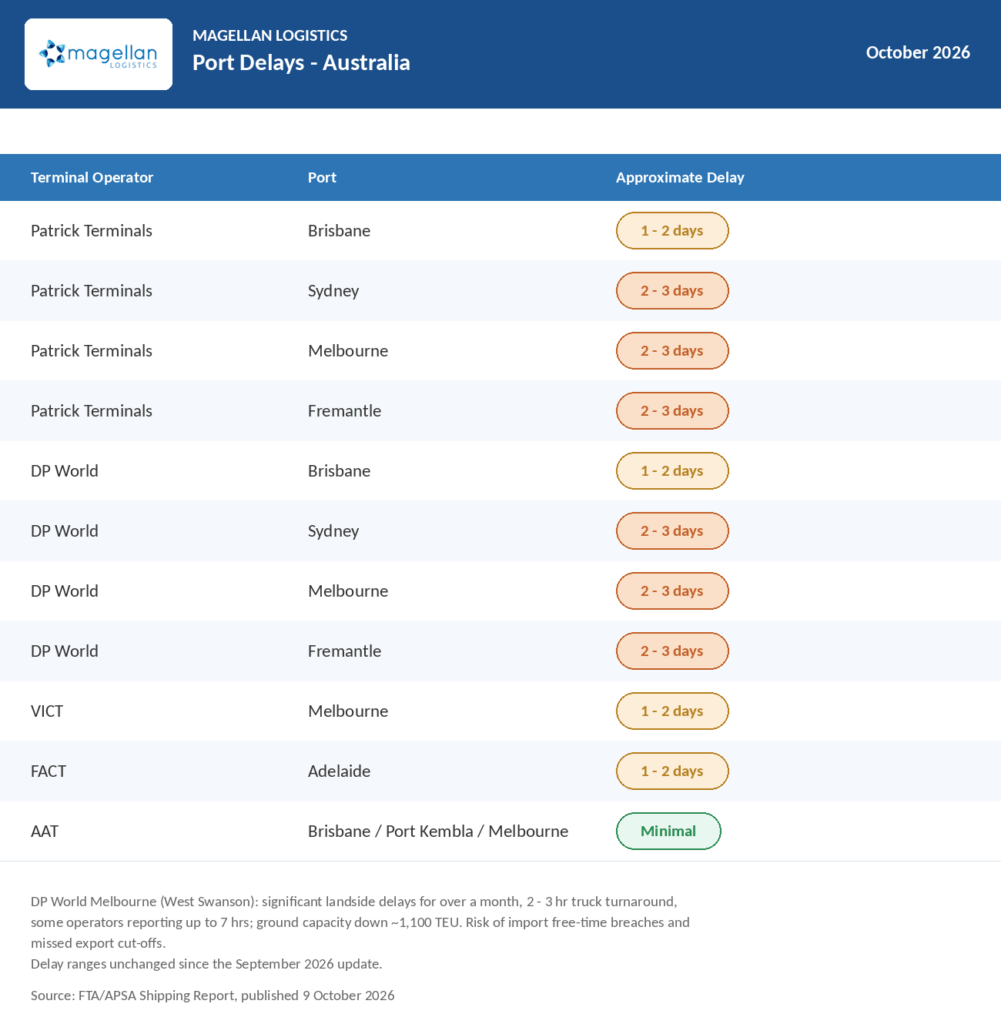
The most significant local issue remains DP World West Swanson in Melbourne, where landside delays have now continued for more than a month. Truck turnaround times are running at two to three hours, some transport operators report waits of up to seven hours, and the terminal has routinely reported no available vehicle booking slots. Personnel issues over the recent long weekend added to existing pressure from vessel bunching, higher volumes and civil works that have cut ground capacity by around 1,100 TEU. Where containers cannot be collected on time, free time has been extended and storage fees waived. DP World is adding labour and booking slots, but a heavy forward vessel schedule points to continued pressure.
Elsewhere, terminal delays are unchanged since our September update, ranging from minimal at AAT facilities to two to three days at Patrick and DP World in Sydney, Melbourne and Fremantle.
New Zealand
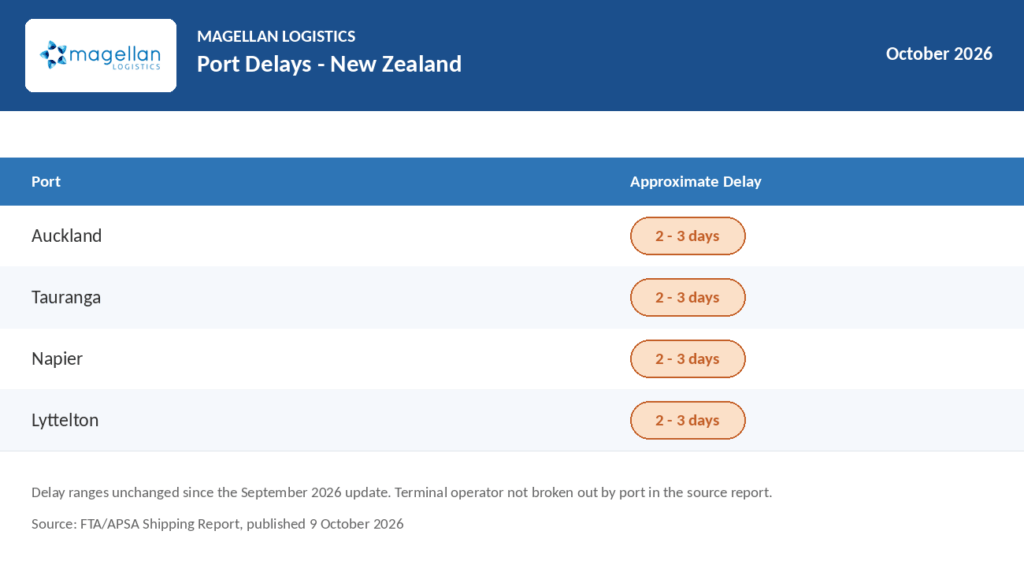
Auckland, Tauranga, Napier and Lyttelton continue to run at approximately two to three days, unchanged since last month.
Notable Infrastructure and Regulatory Developments
OOCL has partnered with ITC on a daily rail service from Somerton into the Port of Melbourne, giving shippers in Melbourne’s north another way to move containers to and from the port.
What this means for you
If you import via West Swanson, allow extra time between discharge and delivery, talk to your wharf cartage provider early about booking slots, and confirm whether free time extensions apply to your containers rather than assuming they do. Exporters delivering there should allow more time to meet vessel cut-offs.
The Bottom Line
October’s freight market update shows the pressure moving closer to home. Asia to Australia freight rates have paused, but restorations and surcharges are already in place to hold them up. Global reliability has slipped below 50%, the most immediate disruption for many importers is at the terminal gate in Melbourne, and exporters face a firm new documentation deadline from Maersk.
None of this calls for alarm, but it does reward early planning and realistic delivery dates. With more than 28 years of industry experience, customs licensing across Australia and New Zealand, and a dedicated account manager assigned to every client for continuity, Magellan Logistics helps you navigate the challenging and uncertain world of freight and logistics so you can focus on running your business.
If you would like to talk through what these changes mean for your shipments before the end of the year, we would be glad to help. Speak to an expert, and let’s start a conversation about propelling your business forward.
Read previous freight market updates and the latest logistics insights at Freight Forwarding News and Insights – Magellan Logistics
About David Thatcher: David, founder of Magellan Logistics, has built a global career in freight forwarding. With international leadership experience and Harvard training, he remains committed to client needs and nurturing his team.
Sources: With thanks to the Freight and Trade Alliance for their freight market update. Figures attributed to Drewry, Sea-Intelligence, WorldACD, UNCTAD, Australian Border Force, and the Australian Bureau of Statistics, as reported in the latest FTA/APSA Shipping Report.