
Welcome to the Magellan Logistics freight market update for August 2026. Global container rates have finally begun to soften after a turbulent July, but that easing has not reached Australia. South East Asia to Australia pricing accelerated sharply through the month, a new 12.5% US tariff has landed on Australian exporters, and the Strait of Hormuz remains a live commercial risk even as diplomacy continues. For importers and exporters across Australia and New Zealand, the picture is one of relief in some corners of the market and fresh pressure in others.
This freight market update draws on the latest FTA/APSA Shipping Report, together with data from Drewry, UNCTAD, WorldACD and the Australian Border Force, translated into what it means for your business.
TL;DR – Global Freight Market Update August 2026
- Global ocean rates have turned down. Drewry’s World Container Index has fallen for three straight weeks, though it remains higher month on month than late June.
- South East Asia to Australia rates accelerated sharply through July, now demanding separate attention from the North East Asia trade.
- The United States has confirmed a 12.5% additional duty on most Australian-origin goods under Section 301, effective from 24 July.
- The Strait of Hormuz remains rated a severe risk, with vessel transits still a fraction of pre-conflict volumes and a renewed attack in the Bab el-Mandeb Strait on 11 August.
- Western Sydney International’s new 24-hour Cargo Precinct opened on 27 July, adding significant new air freight capacity for Greater Sydney.
- Blank sailings to Australia have fallen to 6.0%, but that is not a sign of calm: a run of typhoon activity has kept vessels delayed across North Asia, tightening space and adding to rate pressure.
Freight Market Update: Middle East Disruption
Negotiations between the United States and Iran over the future of the Strait of Hormuz continue, but progress remains fragile. Talks have reportedly made headway on defining shipping lanes between Iranian and Omani waters, yet the wider political conditions needed to fully reopen the Strait, including sanctions relief and the question of transit charges, remain unresolved. Before the conflict began at the end of February, around one fifth of global oil and gas supplies passed through the Strait each day.
What AU/NZ Shippers Need to Know
Vessel-tracking data shows only around eight vessels transiting the Strait each day, against a pre-conflict average of 130 to 140. The Joint Maritime Information Center rates the Strait as a severe risk, the highest of any monitored corridor in the region. As we outlined in our earlier look at the Strait of Hormuz disruption, exposure for Australian and New Zealand shippers is largely indirect, but real: higher bunker and jet fuel costs, war-risk premiums and altered carrier routings continue to filter through to freight rates and transit reliability.
Iran has proposed sharing management of the Strait with Oman and has linked reopening to compensation and an end to US military pressure, while the United States has rejected any arrangement that would let Tehran impose compulsory transit charges. Eight of the world’s leading shipping organisations have jointly urged the United Nations and IMO to defend free navigation through the Strait, warning that a toll would set a precedent for other chokepoints.
Red Sea Update
On 11 August, a commercial vessel was attacked in the Bab el-Mandeb Strait in an incident attributed to Yemen’s Houthi forces, with several crew and rescuers reported killed. The same day, US forces struck a Panama-flagged container vessel in the Gulf of Oman that Washington said had attempted to breach its blockade of Iranian ports. Carriers now face elevated risk at two of the Middle East’s key maritime gateways at once, after years spent managing Red Sea risk through diversion around the Cape of Good Hope alone.
What This Means For You:
Build flexibility into your routing and transit-time expectations for any cargo connected to the Middle East, and keep a close eye on carrier-specific Gulf surcharges. We monitor these developments daily and can help you weigh the cost of holding buffer stock against the risk of delay. Speak to an expert about your exposure.
Freight Market Update: Rates and Services
Global Ocean Rates
Global spot rates have turned a corner. Drewry’s World Container Index fell 3% in the week to 30 July, its third consecutive weekly decline and a fall of 8.3% since the 9 July peak, though the index remains around 2% higher than late June. On the Transpacific, Shanghai to Los Angeles eased 2% and is little changed month on month, while Shanghai to New York held firm, still around 6% above late-June levels as frontloading softens following new US tariff measures. Asia-to-Europe rates were mixed: Shanghai to Genoa fell 6%, while Shanghai to Rotterdam eased 3% but remains around 6.5% higher month on month. Intra-Asia rates fell 11% month on month, now roughly 14% below their June peak. Weakening demand is being offset by tighter capacity management, port congestion and new fuel surcharges linked to Middle East tensions and a 24% rise in oil prices, so further volatility looks the more likely path.
Australia
Australia has not shared in the global easing. July was characterised by sustained pressure on Asia-to-Australia freight, with drivers shifting from pure demand growth towards congestion, typhoon-related delays and carrier efforts to restore pricing. North East Asia remains the primary pressure point, but South East Asia to Australia rates accelerated sharply through the month and, by late July, had become one of the market’s most significant developments. We would encourage clients to treat these as two separate markets rather than a single Asia-to-Australia trade.
Carriers have layered on further cost pressure. ANL and CMA CGM revised inland fuel surcharges, lifting rail charges by 8.3%, road by 4.4% and barge by 4.5%. Several lines, including ANL, CMA CGM, COSCO, MSC, Neptune Pacific, ZIM and GSL, have announced rate restorations, new fuel surcharges or an emergency space surcharge effective through early August. On services, Maersk is bringing back its Melbourne Star seasonal inducement for a third consecutive year, while ZIM and Gold Star Line have resumed a China-to-Australia vehicle service linking Shanghai with Brisbane, Port Kembla and Melbourne. FTA and APSA expect demand to be waning, so rates should begin easing in the months ahead.
What This Means For You:
With North East Asia and South East Asia now moving on different tracks, it is worth reviewing your contract terms against both trades separately rather than assuming one increase applies evenly across your network. Speak to your dedicated account manager about which restorations and surcharges genuinely apply to your cargo.
Freight Market Update: Trade Outlook
The OECD’s latest Economic Outlook projects world trade growth moderating from 5.0% in 2025 to 3.1% in 2026 and 2.9% in 2027, with global GDP growth slowing over the same period before a modest recovery. The OECD links ongoing Middle East disruption directly to higher energy, fertiliser and industrial input costs, and confirms that global ocean freight rates remain around 45% above pre-conflict levels, with air freight around 30% higher. The WTO’s Goods Trade Barometer tells a similar story: global merchandise trade is holding above trend, but momentum is easing, with container shipping and international air freight indices both still signalling expansion, driven largely by demand for electronic components linked to AI-related investment.
US Shipping Update
Australian exporters received a significant piece of news in July. The United States has finalised Section 301 tariffs targeting 60 economies, including Australia, following investigations into forced labour import prohibitions. Most Australian-origin goods are now subject to an additional 12.5% duty entering the United States, effective from 24 July, unless a specific exemption applies. The decision arrives despite Australia’s own modern slavery reporting framework, and is notable for exporters selling into price-sensitive US markets, where the duty uplift may affect competitiveness and landed cost calculations. Our customs and compliance team can help you review your documentation.
What This Means For You:
If you export to the United States, now is the time to model the impact of the additional 12.5% duty on your landed costs and revisit your supply chain documentation. Speak to an expert about your options.
Global Schedule Reliability
Global schedule reliability eased slightly in June, down 1.9 percentage points month on month to 62.6%, though this remained the second-best result of 2026 so far. Maersk again led the major carriers at 77.1%, followed by Hapag-Lloyd at 75.6% and MSC at 72.1%, the only three above 70%, while Wan Hai recorded the lowest reliability at 35.6%. Average delays for late vessels improved slightly to 5.31 days, though this remained higher than the same period last year. Among the alliances, Gemini Cooperation continued to set the pace at 93.4% reliability.
Global Port Congestion
Port congestion remained elevated through July after reaching a four-year high entering the month. Congestion became more concentrated in North Asia, where a run of typhoon activity in recent weeks, combined with vessel bunching, created significant backlogs at Shanghai and Ningbo, while conditions improved or stabilised at several European and South East Asian ports. That disruption is doing much of the capacity management carriers would otherwise handle through blank sailings, a dynamic we unpack further below.
What This Means For You:
Reliability figures hide real differences between carriers and hubs. If your cargo transits Shanghai, Ningbo or other congested North Asian gateways, build extra buffer into your planning. We factor real schedule performance, not just headline transit times, into every booking we make for you.
Freight Market Update: Capacity Management and Blank Sailings
Global
Carriers have tightened capacity management again, with 52 blank sailings expected across the major East-to-West trades over the next five weeks, up sharply from 24 flagged last month. That represents a cancellation rate of around 7%, with 93% of scheduled services still expected to operate. Gemini Cooperation recorded the lowest blank sailing rate among the major carrier groups, at just 1%, underlining its continued disciplined approach to capacity.
Australia
The picture in Australia looks encouraging at first glance. The blank sailing rate declined from 9.43% to 6.0% during the month, a fall of 3.43 percentage points and a marked improvement on the 13.9% rate recorded two months earlier. Look closer, though, and the explanation is less reassuring. A run of typhoon activity across North Asia in recent weeks has kept vessels delayed and schedules disrupted, effectively doing the capacity management carriers would otherwise handle through deliberate blank sailings. Vessel waiting times at Shanghai have already stretched to 77 hours, and that congestion is tightening available space into Australia and adding to the rate pressure we are seeing on the South East Asia trade.
What This Means For You:
A lower blank sailing rate is not the same as a calmer market right now. The underlying disruption has not gone away, it has simply shifted from cancellations to delays, and that is squeezing space and pushing rates higher. Book earlier than usual and build extra buffer into your transit expectations, particularly for cargo moving through North Asian hubs. Speak to your account manager about locking in space ahead of your required dates.
Freight Market Update: Equipment
Container equipment availability remains a live issue for Australian exporters, particularly for reefer and other specialised units. Shortages persist across several shipping lines, compounded by tighter vessel capacity and an earlier-than-usual peak season, making it harder to secure both space and the right box at short notice. Further out, India has announced a Container Manufacturing Assistance Scheme worth around AUD $1.8 billion over five years, aimed at lifting its domestic container production towards 750,000 TEU a year. It is a reminder that equipment supply, and the pricing that follows it, remains a structural issue well beyond any single month’s numbers.
What This Means For You:
If your cargo depends on reefer or specialised equipment, book well ahead of your required loading date. We plan equipment needs early for our clients so a shortage does not become your problem. Let’s start a conversation about your seasonal requirements.
Sustainability
The industry’s energy transition continues to move from pilot to practice. OOCL completed its first green methanol bunkering operation for the OOCL Wisdom, currently the world’s largest methanol dual-fuel container ship, the first of seven methanol-capable vessels the carrier plans to bring into service. Closer to home, the Victorian Government has launched a $1.5 million Electric Heavy Vehicle Trial with Cahill Transport and the Victorian Transport Association, helping freight operators understand the real-world costs and performance of zero-emission trucks across a freight sector worth around $36 billion in that state alone.
Air Freight Market Update
Global
Global air cargo markets softened through July, though rates remain well above last year’s levels. Average rates fell around 3% week on week by mid-month, but are still approximately 24% higher than the same period in 2025, with spot rates more than 30% above last year despite easing from June’s highs. Asia-Pacific tonnages were affected by Typhoon Bavi and new European Union import requirements from 1 July, which saw cargo flows from China and Hong Kong decline as shippers adjusted to the removal of EU de minimis concessions. Volumes from Asia-Pacific into North America, by contrast, held above 2025 levels. Capacity growth has continued but not fast enough to bring rates back to pre-disruption levels on the Asia-Pacific lanes.
Australia and New Zealand
For Australian importers and exporters, the key development in July was the opening of Western Sydney International’s purpose-built 24-hour Cargo Precinct on 27 July, Australia’s first major new international airport in more than 50 years. FTA/APSA described it as a “major new trade gateway” that should improve supply chain resilience and encourage greater competition. First-stage capacity is expected to reach around a quarter of a million tonnes of freight a year, scaling to 1.8 million tonnes, with direct connections to the upgraded Northern Road and M12 Motorway. Initial cargo partners include Qantas Freight and dnata Cargo. Air freight remains a premium-priced market, but the new capacity is a genuinely positive development for time-critical cargo.
What This Means For You:
When ocean transit times are uncertain, air freight can protect a critical delivery, particularly with new capacity now coming online in Sydney. We offer weekend uplifts, deferred services and multiple airline options to match speed and cost to your needs.
Terminals and Ports
Australia
Australian Border Force cargo reporting for June showed sea cargo import reports up slightly month on month but down 7% year on year, while air cargo import reports rose 10% year on year. Overall air and sea cargo activity was up 10% year on year, and export declarations for May were up 2%. In terminal news, DP World secured a Federal Court ruling supporting new crane automation technology at its Fremantle terminal, removing a key hurdle for its Australian modernisation programme, even as the Maritime Union of Australia continues to oppose AI-enabled and remotely operated crane systems.
New Zealand
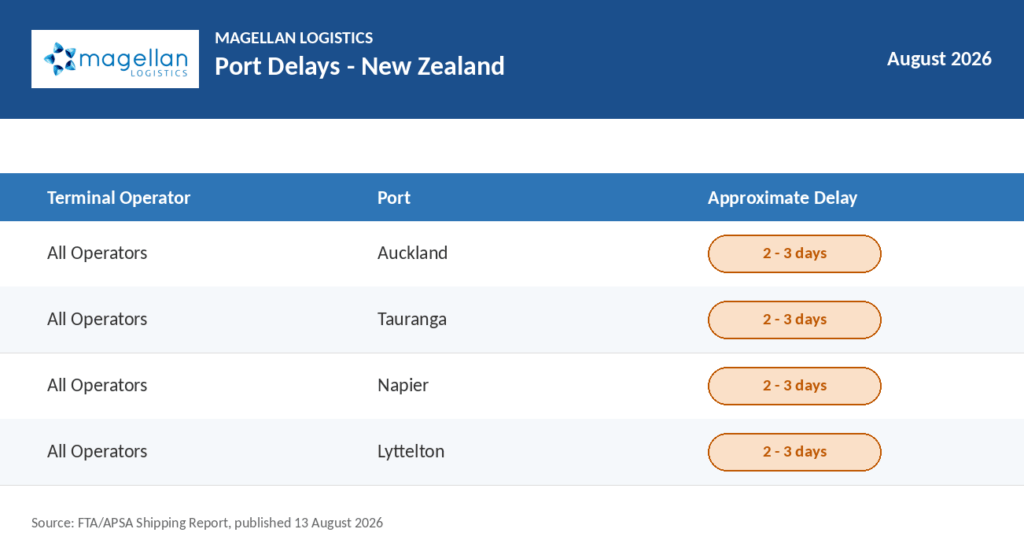
Across New Zealand, the main container ports continued to run with moderate delays of around two to three days.
Significant Landside Delays at DP World West Swanson
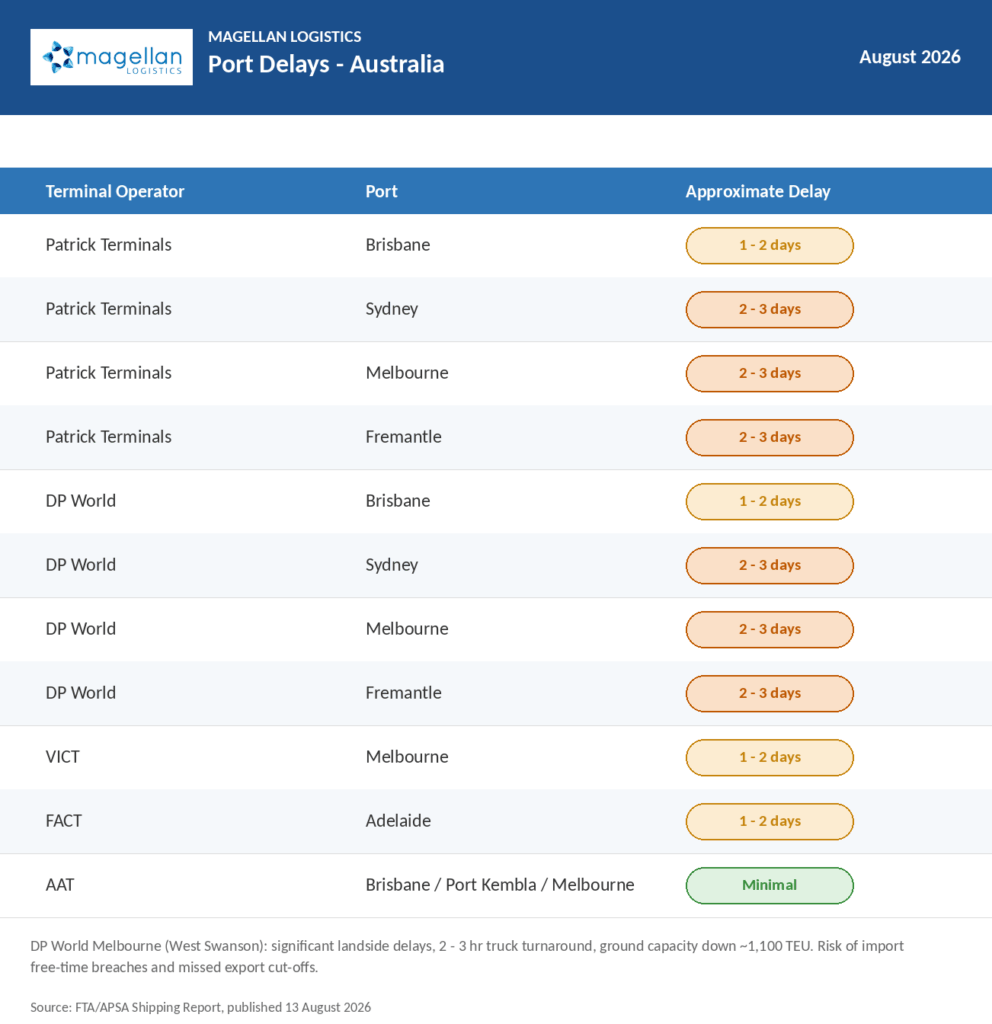
DP World’s West Swanson terminal in Melbourne is experiencing significant landside delays, with truck turnaround times extending to between two and three hours. The disruption is attributed to a combination of vessel bunching, increased container volumes, and ongoing civil works that have reduced terminal ground capacity by around 1,100 TEU. Container transport operators have warned that scheduling pressure is increasing labour and staging costs and raising the risk of import containers exceeding free-time windows and exports missing vessel cut-offs. DP World has stated that additional labour is being allocated and more vehicle booking slots will be made available, though concerns remain given the heavy forward vessel schedule and the potential for further pressure as seasonal volumes increase.
What this means for you
If you move cargo through Melbourne, build extra time into your collection and delivery windows around West Swanson right now. Missed free-time windows and vessel cut-offs carry real cost, in demurrage, detention and rebooking fees. Talk to your dedicated account manager about adjusting your Melbourne bookings while this persists.
Notable Infrastructure Developments
Patrick Terminals has placed a significant order with Kalmar for 10 hybrid straddle carriers for its Melbourne terminal and 12 hybrid AutoStrads for its automated Sydney terminal, due by the second quarter of 2027 as part of its decarbonisation strategy. Elsewhere, ACFS Port Logistics entered administration during July, though operations across its national network have since stabilised, with terminal access and empty container park servicing resolved within days. DP World’s West Swanson terminal in Melbourne is experiencing landside delays, with truck turnaround times of two to three hours attributed to vessel bunching, higher volumes and civil works that have temporarily reduced ground capacity.
What This Means For You:
Port charges, terminal delays and administration events all affect your landed cost and delivery timing. We track terminal performance across Australia and New Zealand so we can route your cargo to avoid the worst of the disruption. Speak to an expert about optimising your terminal choices.
The Bottom Line
The freight market heading into the second half of August is a study in contrasts. Global ocean rates are finally easing after a difficult July, but that relief has not reached Australia, where South East Asia pricing has accelerated, and North East Asia remains under pressure. A new 12.5% US tariff adds a fresh cost layer for exporters, and the Strait of Hormuz and Red Sea continue to inject genuine uncertainty into both sea and air freight.
It is not all pressure. Western Sydney International’s new Cargo Precinct is a genuinely positive addition to the country’s freight infrastructure, and one worth watching. The lower blank sailing rate, though, is not the relief it first appears to be: it reflects typhoon-driven delays across North Asia, which are doing carriers’ capacity management for them, and congestion is adding to rate pressure rather than easing it. None of this is cause for alarm, but all of it rewards careful planning.
This is exactly the environment where dedicated account managers earn their place. With 28 years of industry experience, customs licensing across Australia and New Zealand, and dedicated account managers who own the problem, Magellan Logistics helps you navigate the complexity so you can focus on running your business. If you would like to review your freight strategy for the months ahead, we would be glad to help. Speak to an expert, and let’s start a conversation about propelling your business forward.
Ready to review your freight strategy for the second half of the year? Speak to an expert today.
Read previous freight market updates and the latest logistics insights at Freight Forwarding News and Insights – Magellan Logistics
About David Thatcher: David, founder of Magellan Logistics, has built a global career in freight forwarding. With international leadership experience and Harvard training, he remains committed to client needs and nurturing his team.
Sources: With thanks to the Freight and Trade Alliance for their freight market update. Figures attributed to Drewry, Sea-Intelligence, WorldACD, UNCTAD, Australian Border Force, and the Australian Bureau of Statistics, as reported in the latest FTA/APSA Shipping Report.