
The Errors That Cost Importers the Most Time and Money
TL;DR
- Incorrect tariff (HS code) classification can lead to reassessed duty, penalties and shipment delays. The applicable penalty depends on the offence and the penalty-unit value in force at the time.
- Missing eligible ChAFTA duty concessions means paying unnecessary duty on every shipment until the error is caught and corrected.
- Import records, including certificates of origin, must be retained for five years, and the ABF can review past declarations retrospectively.
- Undervaluing goods on a commercial invoice is customs fraud, carrying fines, seizure of goods and potential criminal prosecution, not a minor shortcut.
- Most of these mistakes are avoidable with correct documentation and classification prepared before goods depart China, not after they arrive.
Most compliance problems at the Australian border are not the result of dishonesty. They are the result of small, avoidable errors made early in the process, often before the goods have even left China, that only become visible once a shipment is already on the water or sitting at the terminal.
This guide covers the mistakes we see most often, what they really cost, and how to avoid them.
For Australian businesses importing from China, these mistakes become more consequential. The distance and complexity of the China-Australia supply chain means errors made early in the sourcing or documentation process are harder to spot and correct before goods are in transit or at the terminal. Many of these mistakes can be prevented entirely with proper documentation and planning before goods leave the factory.
1. Incorrect Tariff Classification
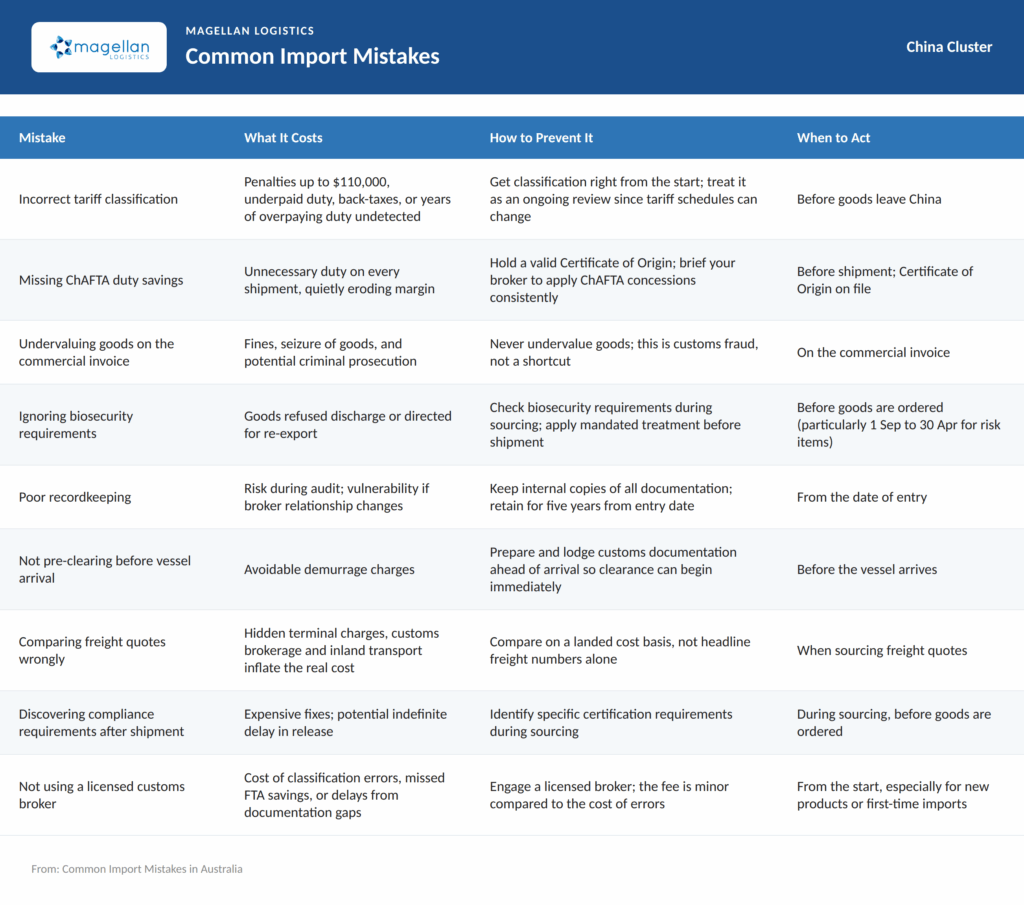
Goods imported into Australia must be classified under the customs tariff. For consignments valued over AUD 1,000, the tariff classification is recorded in the formal import declaration, and it determines the duty rate, ChAFTA eligibility and whether other agencies such as DAFF or the Therapeutic Goods Administration have a say in the shipment. Incorrect classification can lead to underpaid duty, back-taxes and penalties in an ABF compliance review. The applicable penalty depends on the offence and the penalty-unit value in force at the time. It can equally mean overpaying duty for years without realising it. How customs clearance works in Australia explains where classification is assessed and by whom.
2. Missing ChAFTA Duty Savings
Many Chinese-made goods qualify for reduced or zero duty under the China-Australia Free Trade Agreement, provided a valid Certificate of Origin is held. Our guide to importing from China with ChAFTA covers eligibility and certification. Importers who do not claim this, or whose broker is not briefed to apply it consistently, simply pay unnecessary duty on every shipment, quietly eroding margin without any obvious red flag to catch it. Duty is one of the larger variables in China to Australia shipping costs.
3. Undervaluing Goods on the Commercial Invoice
Occasionally a supplier will offer to understate the invoice value to reduce duty payable. This is customs fraud, not a grey area, and carries real consequences including fines, seizure of goods and potential criminal prosecution. No margin saving is worth this exposure.
4. Ignoring Biosecurity Requirements
Goods containing wood, plant material or certain natural fibres may require fumigation or heat treatment before DAFF will release them, and goods shipped from China during the Brown Marmorated Stink Bug risk season between 1 September and 30 April face mandatory treatment requirements. Missing this is not simply a delay; untreated high-risk goods can be refused discharge or directed for re-export entirely. Because of strict compliance requirements, biosecurity mistakes are among the most common import errors Australian shippers encounter.
5. Poor Recordkeeping
Import declarations, certificates of origin, fumigation certificates and supporting documentation must be retained for five years from the date of entry, and the ABF can request them during an audit. Storing critical evidence only with a freight forwarder or broker, rather than keeping internal copies as well, creates unnecessary risk if that relationship ever changes.
6. Not Pre-Clearing Before the Vessel Arrives
Waiting until a container has already been discharged to begin preparing customs documentation is one of the most common causes of avoidable demurrage. Preparing and lodging documentation ahead of arrival allows clearance to begin the moment the container is available, which is the single most effective way to avoid demurrage and detention.
7. Comparing Freight Quotes That Exclude Destination Charges
A cheap-looking ocean freight rate that excludes Australian terminal handling, customs brokerage and inland transport is not a genuine comparison against a competitor’s all-in quote. Always compare on a landed cost basis, not the headline freight number.
8. Discovering Compliance Requirements After Goods Have Shipped
Products requiring specific certification, such as the Regulatory Compliance Mark for electrical goods or Food Standards Australia New Zealand labelling requirements for food products, need to be identified during sourcing, not after the container has already left China. Finding out post-arrival is expensive and can delay release indefinitely until the requirement is met.
9. Not Using a Licensed Customs Broker
Using a broker is not a legal requirement, but the fee is minor compared to the cost of a classification error, a missed FTA saving, or a delay caused by an avoidable documentation gap. This is particularly relevant for first-time importers or anyone bringing in a new product line for the first time.
How to Avoid Most of These Common Import Mistakes in Australia
- Classify goods correctly from the outset and treat classification as an ongoing review rather than a one-off task, since tariff schedules and rules can change.
- Brief your customs broker explicitly to apply ChAFTA concessions wherever eligible and keep Certificates of Origin on file.
- Check compliance and certification requirements during sourcing, before goods are ordered, not after they have shipped.
- Keep your own internal copies of all import documentation, not just what your broker or forwarder holds.
- Prepare and lodge customs documentation ahead of vessel arrival rather than after discharge.
Avoid the Common Import Mistakes That Cost Australian Shippers the Most
Most of the costliest import mistakes are avoidable with the right process in place from the start. Let the experts at Magellan Logistics manage classification, compliance and documentation when importing goods from China, so avoidable errors do not become expensive ones.
Speak to an expert and let’s start a conversation about your next shipment.
____________________
About David Thatcher: David, founder of Magellan Logistics, has built a global career in freight forwarding. With international leadership experience and Harvard training, he remains committed to client needs and nurturing his team.